
D-Day: The Longest Day That Changed the World
On June 6, 1944, Allied forces crossed the English Channel and launched the largest amphibious invasion in military history. The operation, forever known as D-Day, opened the long-awaited Western Front against Nazi Germany and marked the beginning of the liberation of occupied Europe.
More than 156,000 Allied soldiers, sailors, and airmen participated in the assault on the beaches of Normandy. Many would never return home. Their courage on what became known as “The Longest Day” altered the course of World War II and helped secure the eventual defeat of Adolf Hitler’s regime.
On this anniversary of D-Day, we remember not only a remarkable military achievement, but also the extraordinary sacrifices made by those who stormed the beaches of Normandy under fire.
The Allied Forces
The invasion, officially designated Operation Overlord, involved troops from several Allied nations, led primarily by the United States, Great Britain, and Canada.
The overall commander of the operation was General Dwight D. Eisenhower, Supreme Commander of the Allied Expeditionary Force. Eisenhower bore ultimate responsibility for the success or failure of the invasion and made the momentous decision to proceed despite uncertain weather conditions.
Ground forces were commanded by British General Bernard Montgomery, while naval forces were directed by Admiral Bertram Ramsay and air operations by Air Chief Marshal Trafford Leigh-Mallory.
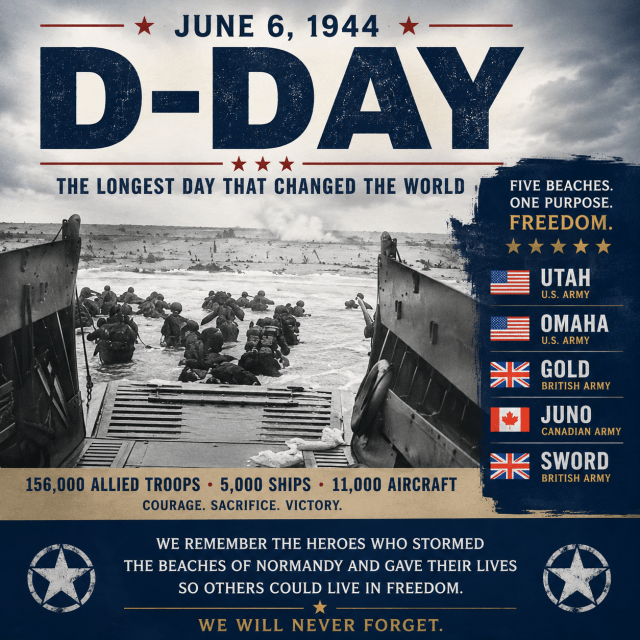
Approximately 156,000 Allied troops landed in Normandy on June 6, 1944.
The five assault beaches were assigned as follows:
- Utah Beach – United States Army
- Omaha Beach – United States Army
- Gold Beach – British Army
- Juno Beach – Canadian Army
- Sword Beach – British Army
Supporting the landings were more than 5,000 ships and landing craft, nearly 11,000 aircraft, and tens of thousands of sailors, airmen, engineers, medics, and support personnel. The scale of the operation was unprecedented and remains one of the greatest logistical achievements in military history.
The German Defenders
The German forces defending Normandy were part of Adolf Hitler’s Atlantic Wall, an extensive network of fortifications stretching along the coast of Western Europe.
The overall German commander in France was Field Marshal Gerd von Rundstedt, while Field Marshal Erwin Rommel, famed for his campaigns in North Africa, was responsible for strengthening the coastal defenses.
Rommel believed that the invasion had to be stopped at the water’s edge. He directed the placement of mines, beach obstacles, artillery positions, bunkers, and machine-gun nests designed to destroy Allied forces before they could establish a foothold.
Despite these preparations, German commanders remained uncertain where the invasion would occur. Through an elaborate deception campaign, Allied planners convinced many German leaders that the main attack would strike near Pas-de-Calais rather than Normandy.
Casualties
The cost of D-Day was severe.
Allied Casualties
On June 6 alone, Allied forces suffered approximately:
- 4,400 killed
- More than 10,000 total casualties, including wounded and missing
American forces endured the heaviest losses at Omaha Beach, where German defenses remained largely intact and troops were subjected to devastating machine-gun and artillery fire.
Many landing craft were destroyed before reaching shore. Others delivered soldiers into deep water under enemy fire. In numerous sectors, units became disorganized, officers were killed, and communications failed. Yet small groups of soldiers pushed forward, scaling bluffs, attacking fortified positions, and creating the breakthroughs necessary for success.
German Casualties
German casualties are more difficult to determine precisely, but historians generally estimate:
- Approximately 4,000 to 9,000 casualties, including killed, wounded, missing, and captured
Unlike the Allies, Germany could not easily replace these losses, particularly among experienced officers and non-commissioned officers.
Why D-Day Mattered
The strategic significance of D-Day cannot be overstated.
Establishing a Western Front
For years, Nazi Germany had concentrated much of its military power against the Soviet Union in the east. The Normandy invasion opened a major Western Front, forcing Germany to fight a large-scale war on multiple fronts simultaneously.
Beginning the Liberation of France
The successful landings established a foothold in Western Europe. Within weeks, Allied forces were breaking out of Normandy, and by August 1944 Paris had been liberated after four years of Nazi occupation.
Accelerating Germany’s Defeat
Operation Overlord placed Allied armies directly on the European continent. The advance through France, Belgium, and the Netherlands would eventually carry Allied troops into Germany itself, helping bring the war in Europe to a close less than a year later.
Demonstrating Allied Unity
D-Day showcased extraordinary cooperation among Allied nations. Americans, British, Canadians, Free French forces, and soldiers from many other nations fought together in pursuit of a common goal: the defeat of Nazi tyranny.
The Human Dimension
Maps and casualty figures tell only part of the story.
Many of the men who stormed the beaches were in their late teens or early twenties. They endured rough seas, enemy fire, confusion, and fear. For many, D-Day was their first experience in combat.
At Omaha Beach, entire units suffered devastating losses within minutes. Yet survivors regrouped, found gaps in the German defenses, and continued forward.
Airborne troops dropped behind enemy lines during the night before the invasion often found themselves isolated and scattered across the Norman countryside. Small groups formed impromptu fighting units and carried out their missions despite confusion and separation from their parent commands.
Acts of heroism occurred throughout the invasion. Soldiers carried wounded comrades to safety. Engineers cleared minefields under direct fire. Sailors brought their vessels dangerously close to shore to support troops pinned down on the beaches. Aircrews flew through intense anti-aircraft fire to support the operation.
Success was achieved not through a single dramatic moment, but through thousands of acts of courage performed by ordinary men facing extraordinary circumstances.
A Legacy of Sacrifice
Today, more than eight decades later, D-Day remains one of history’s greatest examples of courage under fire. The men who landed at Utah, Omaha, Gold, Juno, and Sword Beaches faced daunting odds, yet they pressed forward because the success of the mission—and the future of Europe—depended upon them.
The freedom enjoyed today across much of Europe owes much to the sacrifices made on those beaches and in the fields and villages beyond them. As we mark the anniversary of June 6, 1944, we honor the soldiers, sailors, airmen, and Marines who fought that day, especially those who gave their lives in service to a cause larger than themselves.
The white crosses and Stars of David at the Normandy American Cemetery overlook the very shores where so many young Americans fought and died. They stand as a lasting reminder that freedom carries a cost, and that generations before us were willing to pay that price.
Their names may fade from memory, but their achievement never should. The story of D-Day remains a reminder that freedom often depends upon the courage of ordinary people called to perform extraordinary deeds.
On this anniversary of D-Day, we remember them with gratitude, respect, and humility.


A very detailed account of what happened on that important day. Will you be reviewing the new movie “Pressure” about the weather’s impact on the Normandy decision making?
LikeLike