
Memorial Day Remembrance
As Americans pause on Memorial Day to remember those who gave their lives in service to the nation, few battles better symbolize sacrifice, determination, and battlefield courage than the Battle of Iwo Jima. I have read the three book series on the war in the Pacific by Ian Toll, which was really outstanding. The third book in the series, “Twilight of the Gods: War in the Western Pacific 1944-1945” deals with Iwo Jima. Some of this material is sourced from that book.
Fought between February 19 and March 26, 1945, Iwo Jima was one of the bloodiest and most strategically significant engagements of the Pacific Theater in World War II. This small volcanic island, only about eight square miles in size, became the scene of an extraordinary clash between American and Japanese forces in the final months of the war.
American Forces Involved
The assault on Iwo Jima was principally a United States Marine Corps operation, supported by the United States Navy and Army Air Forces.
The primary American ground combat units included:
- 3rd Marine Division
- 4th Marine Division
- 5th Marine Division
These forces formed the V Amphibious Corps, under the command of Lieutenant General Holland M. “Howlin’ Mad” Smith, one of the Marine Corps’ most aggressive and respected combat commanders.
The direct commander of the landing operation itself was Major General Harry Schmidt, commanding V Amphibious Corps during the battle.
Naval support was immense. The U.S. Navy provided pre-invasion bombardment, troop transport, carrier aviation, logistics support, and offshore firepower from battleships and cruisers. Key naval leadership included Admiral Raymond Spruance, commander of the broader Pacific operation, and Vice Admiral Richmond Kelly Turner, overseeing amphibious forces.
The U.S. Army Air Forces also played a critical supporting role, both before and after the battle.
In total, roughly 70,000 American personnel participated in the operation.
The Japanese Commander
Defending Iwo Jima was General Tadamichi Kuribayashi, one of Japan’s most capable military commanders.
Kuribayashi understood that Japan could not win a conventional defense of the island. Rather than attempting to repel the Americans at the shoreline—as had often been Japanese doctrine—he constructed a deeply layered defensive network of tunnels, bunkers, hidden artillery positions, machine-gun nests, and fortified caves.
His strategy was brutally effective.
Instead of suicidal banzai charges, Kuribayashi ordered disciplined resistance designed to inflict maximum casualties. American troops who expected the initial bombardment to have neutralized Japanese defenses instead encountered a hidden, intact enemy prepared for a fight to the death.
Kuribayashi reportedly told his troops they should each kill ten Americans before dying.
Casualties
The human cost was staggering.
American Casualties
American losses totaled approximately:
- 6,821 killed
- 19,000+ wounded
- More than 26,000 total casualties
Iwo Jima remains one of the few Marine Corps battles in which American casualties exceeded those of the defending Japanese force in total numbers.
Among the dead were Marines, Navy corpsmen serving alongside Marines, sailors, and airmen supporting the operation.
The iconic photograph of the flag raising atop Mount Suribachi, taken by Joe Rosenthal, immortalized the battle—but it can obscure the grim reality that the battle continued for more than a month after that moment.
Japanese Casualties
Japanese losses were catastrophic:
- Approximately 18,000–21,000 killed
- Only about 200–1,000 captured alive (depending on accounting)
Most Japanese defenders fought to the death.
General Kuribayashi himself was killed near the end of the battle, though exact circumstances remain uncertain.
Why Iwo Jima Mattered
The strategic importance of Iwo Jima was substantial.
Located roughly halfway between the Mariana Islands and mainland Japan, Iwo Jima served as a Japanese early warning station and defensive outpost.
Its capture offered several key advantages:
1. Emergency Landing Field for American Bombers
American B-29 Superfortress bombers conducting raids against Japan flew long, dangerous missions from bases in the Marianas.
Damaged aircraft often had nowhere safe to land.
Once captured, Iwo Jima became an emergency landing field for crippled bombers returning from Japan, ultimately saving thousands of American aircrew lives.
2. Elimination of Japanese Early Warning Capability
Japanese radar installations on Iwo Jima provided advance warning of incoming American bombing raids.
Capturing the island removed that capability and complicated Japan’s air defense network.
3. Fighter Escort Base
The island became a base for American fighter aircraft, particularly P-51 Mustangs, allowing escort coverage for bomber missions against Japan.
This improved American air effectiveness in the closing months of the war.
4. Stepping Stone Toward Japan
Iwo Jima was part of the island-hopping campaign that moved American forces ever closer to the Japanese home islands.
Its capture signaled that the war had entered its final and most intense phase.
The Nature of the Battle
Iwo Jima was uniquely brutal.
The island’s volcanic ash made movement difficult, preventing Marines from digging effective foxholes and slowing equipment.
Japanese defenses were largely underground and often invisible until they opened fire.
Every yard had to be taken by direct assault.
Flamethrowers, grenades, demolitions, tanks, naval gunfire, and close combat defined the struggle.
The battle became a grim war of attrition.
Even after Mount Suribachi fell, northern portions of the island remained fiercely defended.
The Medal of Honor was awarded to 27 servicemen for actions at Iwo Jima—more than for any other single battle in Marine Corps history.
Fleet Admiral Chester Nimitz famously observed:
“Among the Americans who served on Iwo Island, uncommon valor was a common virtue.”
Memorial Day Reflection
Iwo Jima was not merely a military victory. It was a human ordeal measured in sacrifice.
Thousands of young Americans—many barely out of high school—crossed an ocean, stormed black volcanic beaches under murderous fire, and fought yard by yard against an enemy determined not to surrender.
Many never came home.
This Memorial Day, we honor the Marines, sailors, corpsmen, soldiers, and airmen who gave their lives at Iwo Jima. Their courage helped bring a terrible war to its conclusion, but the cost was written in blood.
The freedoms Americans enjoy today were preserved, in part, by men who climbed into gunfire on a hostile island half a world away and never saw home again.
May their sacrifice never be forgotten.
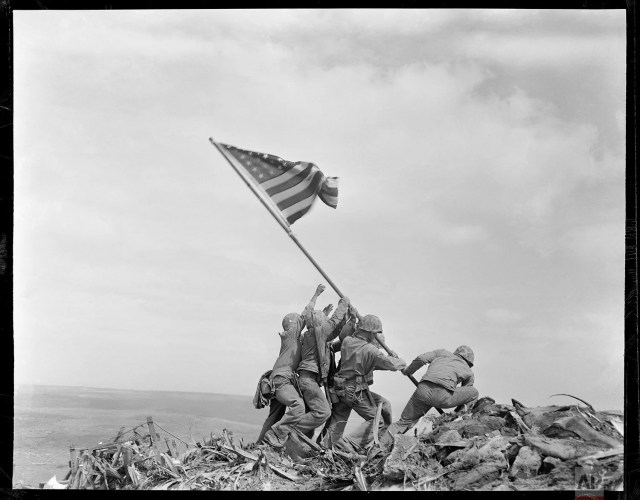


My Dad fought there as both a SeaBee and Marine
Sent from the all new AOL app for iOS
LikeLike