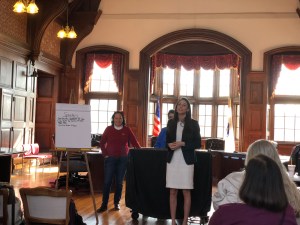
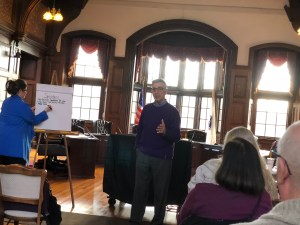
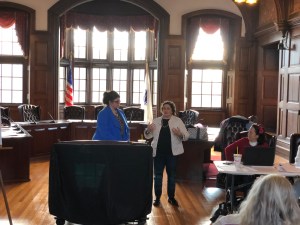
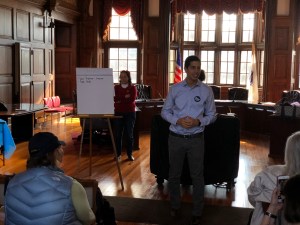
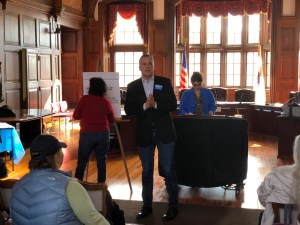
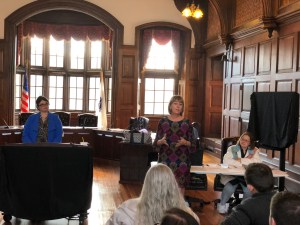
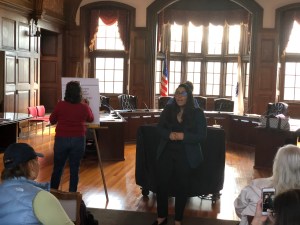
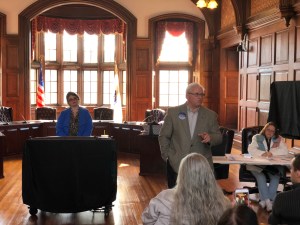
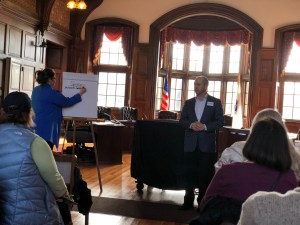
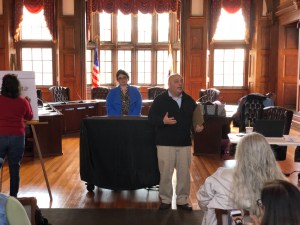
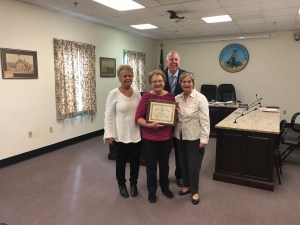
The Seabrook Board of Selectmen, at their March 5, 2018 meeting, were introduced to the Seabrook Police Department’s newest addition, K-9 Dog Henry. The K-9 Program was brought back to Seabrook by the Board of Selectmen, who authorized the initial funding. The project is an initiative of Chief Michael Gallagher, who designated Officer David Hersey as Seabrook’s dog officer. Henry is an approximately 20-month-old Belgian Malinois. Officer Hersey and Henry graduated from the Boston Police Canine Academy in December 2017 and are a patrol certified police canine team. Currently Henry can do article searches (such as for evidence of a crime like a mask, clothing, knives, firearms, wallet, etc), area searches, building searches, tracking (like a missing person), and apprehension (assisting in taking a person into custody). Henry lives with Officer Hersey and they have formal training 8 to 16 hours per month. Officer Hersey and Henry train while off-duty, as well. Officer Hersey and Henry will be attending training in August to become certified in detecting narcotics. Officer Hersey and Henry are currently assigned to the evening patrol shift. Officer Hersey says Henry has adjusted well to family life as well as police work and is proving to be a valuable asset to the Seabrook PD. Henry’s capabilities as a police canine will continue to improve as he matures and gains more experience in the field. Funding for the Seabrook PD canine program was provided by a grant from the Stanton Foundation as well as the estate of Elmo D’Alessandro.
Another book on Hitler? Why take the time, especially since I have read Kernshaw, Shirer, and lots of other writing on the subject. Volker Ullrich has put out the first of two volumes here, with the advantage of some new documentation along with an attempt to look at Hitler from a different perspective. Looking at Hitler’s personal life in the run-up to power, as well as a good look at the political tools he used to achieve that power, and how he governed after his being named Chancellor before the war, made this book worthwhile. I think Ullrich has met his goal with this effort, and it is worth a read.
Because of the monstrous crimes against humanity committed by Hitler he has been easy to caricature. Ullrich tries to get below that, and although some of his early life remains a bit of a mystery Ullrich sheds as much light as possible without engaging in armchair psychiatry. I had two main interests: how did he get there, and how did the Hitler govern before the war? Despite the ultimate horrors brought on by the Nazi regime there has always been an undercurrent that Hitler was personally popular pre-war at least in part due to some success of governance in Germany. While governance in pre-war Germany may be a “boring” part of the story it is, in my view, an important piece of the overall narrative, and something that this book does an effective job of covering.
Hitler’s early life, his start into politics, and the formation of his core beliefs, centered around virulent anti-Semitism linked to his hatred of Bolshevism, is covered extensively. How and when did his anti-Semitism become so fanatical? Ullrich takes a pretty good run at that, but ultimately, with today’s knowledge, cannot fully answer the question. What he does show us is Hitler’s mastery as a politician, his gift of “reading” people, and instinctively understanding their strengths and weaknesses. His powerful oratory, without question, propelled him forward as a politician, but, as Ullrich shows us, his skills were not limited to oratory. Adolph Hitler knew his audience, whether that audience was a gathering of thousands or a much smaller one where he would have to manipulate individuals to achieve a desired result. Hitler the “actor” is shown to be a man of many faces, willing to modulate even his anti-Semitism when he saw advantage to doing so.
“Heiden wrote of “an incomparable barometer of mass moods,” while Otto Strasser spoke of an “unusually sensitive seismograph of the soul.” Strasser also compared Hitler to a “membrane” broadcasting the most secret longings and emotions of the masses. Krosigk concurred. “He sensed what the masses were longing for and translated it into firebrand slogans,” the Reich finance minister wrote. “He appealed to the instincts slumbering in people’s unconsciousness and offered something to everyone.”
Hitler’s success owed much to this “acting” ability, which allowed him to actually move in, and impress, some elements of “polite society” while condemning and vilifying it in his “brownshirt” mode. “Polite society” made the fatal error of underestimating Hitler, believing that they could control him.
“Nonetheless, Hitler had an undeniable ability to don different masks to suit various occasions and to inhabit changing roles. “He could be a charming conversation partner who kissed women’s hands, a friendly uncle who gave children chocolate, or a man of the people who could shake the callused hands of farmers and artisans,” remarked Albert Krebs, the Gauleiter of Hamburg. When invited to the Bechstein and Bruckmann salons or to afternoon tea at the Schirachs’ in Weimar, he would play the upstanding, suit-and-tie-wearing bourgeois to fit in with such social settings. At NSDAP party conferences, he dressed in a brown shirt and cast himself as a prototypical street fighter who made no secret of his contempt for polite society.”
Hitler’s “acting” ability was but one tool he used, besides oratory, to try to win over the German people when he was actually participating in democratic elections. Hitler barnstormed Germany by plane, making many appearances at campaign rallies throughout Germany, carefully orchestrated to enflame local audiences and get his “base” energized for the next election cycle. Hitler used vitriolic anti-semitic attacks during most of his speeches, but his view was that the “other,” whether it be Jews, or others deemed to be a “threat” to the German people, needed to be excised from political and social life in Germany. How did Hitler derive the world view he came to have? His time in Vienna, in poverty, in some fashion, shaped his core beliefs. The author describes some of the political undercurrents in Austria.
“Among Vienna’s ethnic Germans and in the German-speaking parts of the Austro-Hungarian Empire, this massive immigration gave rise to fears of “foreignisation,” of losing the cultural and political hegemony that German Austrians considered their birthright. In reaction, numerous radical nationalist associations, political parties and popular movements had formed since the end of the nineteenth century. That, of course, provoked counter-reactions from other ethnic and cultural groups. One of the main arenas for nationalist conflict was the Reichsrat or Imperial Council, the parliament of the western half of the Austro-Hungarian Empire. In 1907, with the introduction of universal suffrage for men over the age of 24, Germans were no longer the strongest faction there, and the verbal duels fought between the spokesmen for various nationalities, right out in the public eye, were so bitter that many people believed the Habsburg monarchy was in crisis and the multinational state would soon be dissolved.”
Those speeches did not just vilify the “other” but blamed these outside forces for the German defeat in World War I, and for changes in German society that were “corrupting” the German nation, leading to “decline and decay.” He called for a restoration of the great German nation that had existed before these outsiders managed to “sell out” Germany, and create the mess that the nation found itself in.
“His speeches typically began with a look back at “wonderful, flourishing Germany before the war,” in which “orderliness, cleanliness and precision” had ruled and civil servants had gone about their work “honestly and dutifully.”Again and again, Hitler directed his audience’s attention to the “great heroic time of 1914,” when the German people, unified as seldom before, had been dragged into a war forced upon them by the Entente powers. This idealised vision of the past allowed Hitler to paint the present day in hues that were all the darker. Everywhere you looked now, there was only decline and decay. “Why do we stand today amidst the ruins of the Reich Bismarck created so brilliantly?” Hitler asked in a speech in January 1921, on the fiftieth anniversary of the founding of the German Reich. His answer was always the same: the revolution of 1918–19 had been Germany’s downfall, casting it into slavery.”
Hitler even said that the German nation, due to the incompetence of the parliamentary system, was being laughed at by the rest of the world.
“Twelve years of unlimited rule by the old parliamentary parties have turned Germany into an object for exploitation and made it the laughing stock of the entire world,” Hitler thundered.”
Before Hitler took power he had to deal with a relatively free press, who managed to take some pretty good shots at him, even exposing some of the hypocrisy inherent in his finances. Hitler’s reputation was always as a “man of the people,” with no concern or care for money. But when newspapers printed the actual hotel bills for him and his campaign entourage that showed a taste for extravagance Hitler struck back by decrying the publishing of “fake” documents. The charges of “fake” news by Hitler was the best he could do to protect his carefully cultivated image.
“In a declaration on 7 April, the NSDAP chairman hastily declared the published bill a fake, and in his speeches, he continued to contrast himself with the “bigwigs” from the other parties as an unworldly politician who did not have any wealth of his own: “I don’t need any—I live like a bird in the wild.”
Governance in Nazi pre-war Germany has always, in my mind, had a reputation as efficient, with Hitler himself managing to derive credit as someone who managed to re-invigorate the German economic colossus. This book manages to dispel that myth to some degree. What kind of “manager” was Chancellor Adolf Hitler?
“He would arrive in his office punctually at 10 a.m., consult with his most important aides and force himself to read documents. He carefully prepared himself for cabinet meetings in an attempt to impress his conservative coalition partners with his knowledge of details. Hitler had no experience whatsoever in administration, so especially at the start he depended on ministerial civil servants. On the evening of 29 January 1933, in the Hotel Kaiserhof, he allegedly offered the ministerial counsel of the Interior Ministry, Hans Heinrich Lammers, the post of state secretary in the Chancellery with the words that he himself “was no politician and did not know anything of this administration business.” Hitler did not intend to change, but he also did not want to embarrass himself, so he felt he needed “a civil servant who knows his way around.” The more invulnerable Hitler thought his power was, however, and the less heed he had to pay Hindenburg and his conservative coalition partners, the more he tried to duck the routine duties of his office. With visible pleasure he told those around him again and again how people had “tried to get him used to how civil servants worked” and how he had been “so occupied reading through files and going through current issues” that he had no time “to take a calm look at larger problems.” Albert Speer quoted Hitler once saying over lunch: “In the first few weeks, every minute detail was laid before me to decide. I found piles of files on my desk every day, and no matter how hard I worked, they never got any fewer. Until I radically put an end to such senselessness.”
Ullrich, from these examples, gives us a bit of a different perspective on Hitler. In his own fashion he shows us the seeds of the ultimate destruction that Hitler would foist upon the world. Those seeds include a look into Hitler’s views on what the ultimate military goals of an expansionist Germany would be. Much has been written on that subject, with some holding the view that Hitler’s goals were more modest than world domination, assigning to him a desire to expand only to the East, with taking much, if not all of the land-space of the Soviet Union, his main geo-political goal, along with righting the geographic inequities of the Treaty of Versailles. The author shows Hitler’s true thoughts to be much more expansive than that, with a real goal of world domination. You get a sense of Hitler’s ultimate goals through his grandiose architectural plans for Berlin, and other German cities.
“Hitler’s megalomaniacal plans for Berlin can only be understood in conjunction with his hegemonic aspirations abroad. In a sense they anticipated architecturally what had yet to be conquered by martial expansion. “Do you understand now why we plan so big?” he asked Speer one day and provided the answer himself: “The capital of the Germanic Empire.” Nor did the dictator conceal his ambitions from Goebbels. Late one night in mid-March 1937, a few weeks after Speer’s appointment as general building inspector, Hitler told his propaganda minister that he intended to incorporate Austria and Czechoslovakia into the Reich. “We need both to round off our territory,” Goebbels reported Hitler saying. “And we’ll get them…When their citizens come to Germany, they’ll be crushed by the greatness and power of the Reich…Hence the Führer’s gigantic construction plans. He’ll never give them up.” In the early summer of 1939, after Hitler had concluded the first phase of this territorial expansion and was preparing the next one, he stood once again lost in thought before the architectural model and pointed to the swastika-bearing eagle that was to adorn the dome of the People’s Hall. “We’ll change that,” he said. “The eagle won’t be clutching a swastika. It will be clutching the globe!”
How does a racist demagogue assume dictatorial powers over a vast nation, erasing any shred of democratic norms? There were indeed warning voices, but the truth is that those voices were a minority in Germany. Hitler’s true character, and his aims, even early on, were discernible, with some having the courage to speak out.
“Among the casualties of the Night of the Long Knives on 30 June 1934 were two prominent Catholics: Erich Klausener, the director of Catholic Action, one of the most important Catholic lay organisations, and Fritz Gerlich, the publisher of the Catholic weekly Der gerade Weg (The Straight and Narrow). In July 1932, the latter had subjected Hitler’s movement to a scathing analysis in an article under the headline “National Socialism is a Plague.” Gerlich had written: National Socialism…means hostility towards our foreign neighbours, a reign of terror domestically, civil war and wars between peoples. National Socialism means lies, hatred, fratricide and boundless misery. Adolf Hitler is preaching the legitimacy of lying. It is time for those of you who have fallen for the swindle of this power-mad individual to wake up!”
The author has done an admirable job of bringing a new perspective to a subject that has had countless books written. If this area of history is of interest then this book is worth a read. History may not repeat but it gives us powerful lessons that should not be forgotten.
I could not help but see that Rep. Linda Dean Campbell is having a St. Patrick’s Day Fundraiser, the details of which are below. I have also attached a video of her singing performance at a prior St Pat’s event. If you are looking for singing like that please stop by Rep. Campbell’s St Patrick’s day gala on March 11 at the Merrimack Valley Golf Course. You will not be disappointed.
The Methuen Democrats held their caucus this past Saturday, with a great lineup of candidates and speakers. We had a huge contingent of candidates for the open Third Congressional Seat, as well as candidates and incumbents for many other important offices. Our thoughts and best wishes go out to Steve Kerrigan, who announced his withdrawal from the race in the last day. He has an important voice in our Congressional District, and in our State, and is respected by all. The Chair of our Party, Jessica Finocchiaro, did a superb job of keeping the meeting moving and on schedule. Thank you to all those that came out to participate, and for all of the candidates building excitement for 2018. Good luck to all.
Methuen City Councilor Ryan Hamilton, Bill Manzi, and Lori Trahan
Rep. DiZoglio speaks to Methuen Dems.
Former Mayor Zanni speaks to Methuen Dems
Governor’s Councilor Eileen Duff speaks to Methuen Dems
Candidate for Congress Lori Trahan speaks to Methuen Dems
Candidate for Congress Dan Koh speaks to Methuen Dems
Candidate for Congress Lenny Golder speaks to Methuen Dems
Candidate for Congress Patrick Littlefield speaks to Methuen Dems
Candidate for Congress Chad Gifford speaks to Methuen Dems
Candidate for Congress Barbara L’Italien speaks to Methuen Dems
Candidate for Congress Juana Matias speaks to Methuen Dems
Candidate for Congress Bopha Malone speaks to Methuen Dems
Essex County District Attorney Jon Blodgett speaks to Methuen Dems
Candidate for Governor Jay Gonzalez speaks to Methuen Dems
Northern Essex Register of Deeds Paul Iannuccillo speaks to Methuen Dems
Essex County Clerk of Courts Tom Driscoll speaks to Methuen Dems
Methuen Mayor James P. Jajuga hosted a ceremony at the Searles Building, Methuen City Hall, honoring former Mayor Steve Zanni, who had his portrait unveiled and added to the wall outside the Mayor’s Office. The ceremony drew many of Mayor Zanni’s friends, family, and co-workers, and all of the Mayors of the modern era joined with Mayor Jajuga in honoring Mayor Zanni’s distinguished career of service. Terrific job by Nancy Reardon on the portrait of Mayor Zanni.
Emily Sanborn, who has worked for the Town of Seabrook for twenty five years, has retired. The Board of Selectmen recognized her many years of outstanding service to the community with a citation at the February meeting. There was a huge outpouring of affection and support from her co-workers and family. Congrats to Emily, and thank you for a great 25 years of service to the citizens of Seabrook!
The Seabrook Board of Selectmen were on hand at the Seabrook Emergency Room to accept a donation from Portsmouth Hospital, who donated 8 “AED” units to the Seabrook Police Department. An automated external defibrillator (AED) is a portable device that checks the heart rhythm and can send an electric shock to the heart to try to restore a normal rhythm. AEDs are used to treat sudden cardiac arrest (SCA). SCA is a condition in which the heart suddenly and unexpectedly stops beating.
The Seabrook Police Department has AEDs in each of its marked patrol vehicles. While the Seabrook Fire Department is the primary department responsible for responding to medical aid calls, Seabrook Police officers can sometimes be closer to serious medical aid requests when they are out patrolling our streets. Over the years, Seabrook Police officers have deployed the AEDs they carry several times and have had at least one documented save using the AED in 2010.
Seabrook Police Department’s current AEDs were donated in the early 2000’s by Exeter Hospital. Needless to say, the current AEDs are 15+ years old and (for various reasons) are in need of replacement. The Seabrook Police Department has a good working relationship with the Seabrook Emergency Room and turned to them for assistance. The Seabrook Emergency Room administration jumped at the opportunity to outfit the Seabrook Police with eight (8) new Philips AED’s for each of our marked patrol vehicles.
The Board of Selectmen thank Portsmouth Hospital for this generous donation, and recognize the great work by Police Chief Gallagher, and Police Lieutenant Kevin Gelineau in working with Portsmouth Regional Hospital to facilitate this donation.
The 2018 Town of Seabrook warrant is here, attached below. I have also attached an analysis of the capital spending requests contained in the warrant, by Department. In that analysis we take a look below the top line numbers to examine actual tax impacts in 2018.
Congratulations to Mayor Elect Jim Jajuga, who will be sworn in today at Methuen High School at 2:00 p.m. Mayor Jajuga will be Methuen’s fifth Mayor of the modern era following the Charter change that brought us the Mayoral form of government in 1993. Methuen changed to a Town Administrator/Council form in 1973 and then a Town Manager/Council form of government after abandoning Town Meeting. After the 1993 change Methuen had its first Mayoral election since Samuel Rushton won the office before 1920. Mayors, by Charter, are limited to three two year terms. Let us take a look at how those five Mayors won office.
In 1994 Dennis DiZoglio led the ticket in the very large primary field, and then defeated a young upstart City Councilor named William Manzi in the final election. Mayor DiZoglio won three terms as Mayor, and during his tenure the school system built the three K-8 grammar schools (Marsh, Tenney, and the Timony schools.)
Mayor DiZoglio sworn in by Town Clerk James Maloney.
Mayor DiZoglio gives his Inaugural address.
Mayor Sharon Pollard won the first of her three terms by defeating City Councilor Larry Giordano in her first run for that office. Mayor Pollard was a former State Senator, and a former Secretary of Energy for the Commonwealth of Massachusetts, working for Governor Dukakis. A little remembered fact is that then City Councilor Steve Zanni was in that preliminary election for Mayor.
Mayor Pollard posing with the Manzi family at her Inaugural
Following Mayor Pollard was Mayor William Manzi III. (Yes, the same one that lost to Mayor DiZoglio.) In my initial race I defeated Ellen Bahan for the office. In 2006 I was sworn in by none other than today’s Mayor-elect James P. Jajuga, outfitted in a regal set of Justice of the Peace robes. I also served three terms, and was very happy to secure the state financing for the High School project, and get that construction started.
Jim Jajuga swears in Bill Manzi in 2006.
Speaking to the crowd at the Tenney School in 2006.
The third Manzi Inaugural, in the Great Hall, Searles Building.
Mayor Stephen Zanni is leaving office after three terms. Mayor Zanni defeated Al Dinuccio in 2011, and twice won re-election. Congratulations to Mayor Zanni as he completes his third term. He can be proud of many substantial accomplishments, including the completion of the Methuen High School project, and the total renovation of Nicholson Stadium, including brand new artificial turf. I had the pleasure of serving with him as a City Councilor, and also during my tenure as Mayor. We wish him the very best!
Mayor Zanni sworn in by City Clerk Tina Touma-Conway.
Mayor Zanni poses with the newly elected City Council 2012.
The Four Mayors of the modern era pose at the Inaugural of Mayor Zanni in January of 2012.
With Mayor Zanni at his second Inaugural, at the Methuen Memorial Music Hall, 2014.
With Mayor Zanni at his third Inaugural, with City Councilor Ron Marsan.
Mayor James P. Jajuga is Methuen’s fifth Mayor of the modern era, and won election in 2017 while running unopposed. Mayor Jajuga is a former State Senator, has served as the Massachusetts Secretary of Public Safety,as well as having a long and distinguished career as a Massachusetts State Trooper. As a State Trooper Mayor Jajuga headed the Regional Drug Task Force, and is considered an expert on creating and implementing strategies to combat opioid abuse. We wish Mayor Jajuga the very best as he begins his first term as Mayor.
Margaret Macmillan brings us an entertaining and very well written book that details the Nixon opening to China, and how the visit in and of itself changed the world in substantive ways that we are still feeling today. The book title implies a focus on the actual Nixon-Mao meeting, but it brings us so much more than that. The Nixon-Mao meeting ended up being a bit of a substantive disappointment for Nixon. Mao, even in poor health, was simply too cagey to allow the conversation to get into specifics. He outsourced all of the detail work to Premier Zhou en-Lai, and did so, in part, for domestic political reasons. Although not covered in this book Mao would, at a later time, use the Nixon trip as one of several battering rams against Zhou.
Macmillan brings us the back story to the opening, covering the Nixon views on China as he took office after winning the 1968 election. The selection of Henry Kissinger as National Security Advisor brought Nixon together with an individual that is renowned for foreign policy brilliance, but is also renowned for being as much of a publicity seeker as Nixon. While the impetus for the opening came from Nixon it was Kissinger who executed the strategy through negotiations with Premier Zhou en-Lai. The detail work was handled by those two immense personalities, with that interaction providing much of the basis for the summit ending Shanghai Communique.
The book brings us some historical perspective on China, with a strong look at the events leading to the Chinese Communist Party winning the civil war with the Nationalist forces of Chiang Kai-shek, and the follow up to that victory leading to decades of diplomatic isolation between China and the U.S., including the hot war on the Korean peninsula. Without some understanding of that history the significance of the Nixon trip would be a little harder to understand.
For me the star of the show has always been Zhou, who would have to be considered one of the major figures of the 20th century. Zhou was still working one of the greatest high wire acts in political history, navigating through the horrid excesses of the Cultural Revolution, when this diplomatic break through was engineered. Kissinger, in his memoirs, called Zhou one of the most impressive men he had ever met.
“Foreigners who met him generally found him delightful and deeply civilized. Dag Hammarskjöld, the Swedish diplomat who had been the U.N.’s second secretary-general, thought he had “the most superior brain I have so far met in the field of foreign politics.”17 Henry Kissinger, usually quite critical, was completely entranced. “He moved gracefully,” said Kissinger of their first meeting, “and with dignity, filling a room not by his physical dominance (as did Mao or de Gaulle) but by his air of controlled tension, steely discipline, and self-control, as if he were a coiled spring.” Kissinger, who was to have many hours of hard negotiations with Chou, found him “one of the two or three most impressive men I have ever met”—and a worthy adversary. “He was a figure out of history. He was equally at home in philosophy, reminiscence, historical analysis, tactical probes, humorous repartee.” Kindness, compassion, moderation—these were qualities both Chinese and foreigners saw in Chou.”
MacMillan, Margaret. Nixon and Mao: The Week That Changed the World (Kindle Locations 802-804). Random House Publishing Group. Kindle Edition. MacMillan, Margaret. Nixon and Mao: The Week That Changed the World (Kindle Locations 796-802). Random House Publishing Group. Kindle Edition.
The author brings us the complicated goals and objectives of each side, and a fair evaluation of how successful each was in achieving those goals. The clear “bear” in the room was the U.S.S.R., with both sides looking to strike a new equilibrium in world diplomacy by creating a check on Soviet influence and expansion via the new found friendship and joint antipathy towards nations that strove for “hegemony.” Nixon’s “triangulation,” was effective in creating some fear in the Soviet leadership, and without a doubt brought some short term political gains with the Soviets. Nixon was hoping for Chinese help with the intractable North Vietnamese, but on that score he came away disappointed. Zhou was not to be moved on that, but the Chinese, despite not giving Nixon the “help” he sought, took plenty of heat from the North Vietnamese for hosting Nixon while the United States was bombing their country. Zhou made clear that Nixon would leave empty handed on that issue:
“Chou, as he had with Kissinger, refused to commit himself to helping the United States. China, he repeated, when he and Nixon returned to the subject of Indochina two days later, must support its friends, even—and this was a prescient observation on Chou’s part—if the peoples of Indochina embarked on wars among themselves after the Americans left. Whatever occurred would not be the fault of China, which only wanted peace and tranquillity in the region. If North Vietnam was expanding into Cambodia and Laos, he said, ignoring the long history of Vietnamese expansion into its neighbors’ territory, this was only because of its need to counter the United States.”
“We can only go so far,” he added. “We cannot meddle into their affairs.” China would not negotiate on behalf of the peoples of Indochina. Nixon was forced to recognize that, as with the Soviet Union, linkage did not always work: “What the Prime Minister is telling us is that he cannot help us in Vietnam.” Chou underlined the message on February 28 as Nixon was preparing to leave China: “We have no right to negotiate for them. This I have said repeatedly. This is our very serious stand.”
MacMillan, Margaret. Nixon and Mao: The Week That Changed the World (Kindle Locations 4704-4708). Random House Publishing Group. Kindle Edition.
The big elephant in the room was the status of Taiwan, an issue that could have derailed the effort. On this matter both sides had serious political issues to solve, with limited room to maneuver. On the American side Richard Nixon’s long political history had helped to create, over the years, a poisonous atmosphere for any American diplomatic effort to deal with the issue of China, and Indo-China, in a pragmatic way. The “who lost China” attacks on the U.S. State Department and the scourge that was McCarthyism drove our best talent out of the State Department, and Nixon was a big part of that effort. He was considered to be a staunch ally of Taiwan, and I think it fair to say that any effort, before 1968, to normalize relations with “Communist China” would have been met with a vociferous attack by the GOP. President Kennedy had discussions with his foreign policy team about China, and came to the conclusion that it was a subject best left for a second term, with the potential backlash from the “China lobby” not worth the political lift. (John F. Kennedy: A Biography by Michael O’Brien)
“On the right, Senator McCarthy and his supporters, who included a young Richard Nixon, made much of the fact that many American diplomats in China had predicted the collapse of the Guomindang, evidence enough for conspiracy theorists that such men had actively worked for the Communist victory. The diplomats were summoned to congressional hearings, where their motives and loyalty were freely impugned. The impact on the State Department and on the capacity of the United States to understand what was going on in Asia was huge. Seasoned and knowledgeable experts were driven out or resigned in disgust. Those who survived were kept away from anything to do with Asia; one of the department’s leading China specialists ended up as ambassador in Iceland. The department as a whole was shell-shocked and became increasingly timid in offering unpalatable advice to its political masters. A young man who started out as a junior diplomat in Hong Kong in the late 1950s remembered older colleagues who were careful about what they sent back to Washington. “I don’t think it meant not reporting facts,” he said; “it’s just that one was cautious.” On the other hand, the experience of being in Hong Kong tended to make the American China watchers more pragmatic than their superiors back in Washington. The lack of relations between two such big countries seemed absurd, an anomaly that they assumed must be temporary. “Well, you know,” said an American diplomat, “what the hell, China’s there, we’re going to have to recognize it. I mean, it was a fact of life. It wasn’t through admiration, it was just, well, let’s get on with it.”
MacMillan, Margaret. Nixon and Mao: The Week That Changed the World (Kindle Locations 1937-1940). Random House Publishing Group. Kindle Edition.
But Nixon was not about to let his past posturing on this issue prevent progress once he deemed it necessary. While the Shanghai Communique finessed the issue of Taiwan the U.S. concessions were clear, and Kissinger privately promised more to come in a Nixon second teem. (Even Nixon remained somewhat fearful of attacks from the right on this issue.) Despite that fear Nixon’s ruthless embrace of realpolitik, and his willingness to be less than honest with prior allies, drove him forward.
“Nevertheless, in his first years as president, even while he was re-thinking his China policy, Nixon continued to reassure Chiang of his support. “I will never sell you down the river,” he told Chiang’s son in the spring of 1970. As the secret channel to Beijing began to produce results, Nixon had to face doing just that. In April 1971, as they waited anxiously for Chou’s reply to one of Nixon’s messages, Nixon told Kissinger, “Well, Henry, the thing is the story change is going to take place, it has to take place, it better take place when they got a friend here rather than when they’ve got an enemy here.” Kissinger agreed: “No, it’s a tragedy that it has to happen to Chiang at the end of his life, but we have to be cold about it.” In the end, said Nixon, “We have to do what’s best for us.” As Kissinger prepared to leave for his secret trip to China, Nixon gave him some last instructions: “he wished him not to indicate a willingness to abandon much of our support for Taiwan until it was necessary to do so.”
MacMillan, Margaret. Nixon and Mao: The Week That Changed the World (Kindle Locations 4457-4461). Random House Publishing Group. Kindle Edition.
Yet the Chinese Communists had made it amply clear that without American concessions on Taiwan, they were not prepared to move forward to put Sino-American relations on a more normal footing. Moreover, as Chou, a master at diplomacy himself, well knew, negotiations proceed by a combination of clear statements, hints, and suggestions. Kissinger, when it was necessary, gave firm commitments to the Chinese, but he also hinted at more to come once Nixon had been reelected as president in the fall of1972. The United States, he said categorically, did not support the idea of two Chinas or of a mainland China and a Taiwan. The United States accepted the Chinese claim that Taiwan was a part of China, although here he expressed himself cautiously, saying that the United States would like to see a solution of the issue “within the framework of one China.” As he said to Chou, ‘There’s no possibility in the next one and a half years for us to recognize the PRC as the sole government of China in a formal way.’ Once Nixon had made a successful visit to China, Kissinger promised, and once he had been reelected for a second term, the United States would be able to move ahead rapidly to establish full and normal diplomatic relations with the People’s Republic of China. ‘Other political leaders,” he told Chou in what was a familiar theme, ‘might use more honeyed words, but would be destroyed by what is called the China lobby in the U.S. if they ever tried to move even partially in the direction which I have described to you.’ ”
MacMillan, Margaret. Nixon and Mao: The Week That Changed the World (Kindle Locations 4489-4495). Random House Publishing Group. Kindle Edition.
The Chinese side, having the same desire for progress, took the long view on Taiwan, accepting a split view with the Americans on Taiwan, but pocketing the idea that Taiwan was part of China, and the creation of the “One China” policy, which remains U.S. policy to this day.
“Not all the concessions, by any means, came from the American side. The Chinese accepted that the United States could not turn away from Taiwan overnight. Mao was particularly pleased, however, when Kissinger, on his first visit, promised that at least some of the American troops would be pulled out. The United States, Mao exclaimed to Chou, was evolving. Like an ape moving toward becoming a human being, its tail—its forces in Taiwan, in this case—was growing shorter. Armed with Mao’s approval, Chou talked in a friendly and positive way about the gradual lowering of tension over Taiwan and the normalization of relations between China and the United States. Although American troops were clearly going to remain in Taiwan for some time, he conceded that normalization of relations could proceed in parallel rather than, as the Chinese had first insisted, with the troop withdrawal as a precondition. In a chat that autumn of 1971 with Jack Service, a former American diplomat whom he had known during the Second World War, Chou made it clear he understood that American policy on Taiwan would have to evolve over time.”
MacMillan, Margaret. Nixon and Mao: The Week That Changed the World (Kindle Locations 4514-4515). Random House Publishing Group. Kindle Edition.
There is no question that Nixon and Mao painted the broad strokes on the canvas, but Kissinger and Zhou made this effort work. The Shanghai Communique was and is a testament to the essential brilliance and commitment to success that both had. This break-through was as much their achievement as it was their bosses. Kissinger, still alive, remains a subject of bitter controversy for some of the things he did while working for Nixon, but his work here, in my view, was first rate. Secretary of State William Rodgers was essentially ignored by Nixon and Kissinger on this initiative as well as generally. Kissinger expressed some regret over his treatment of Rodgers in his memoirs, and that dynamic is also covered here. With China now newly assertive, and becoming an economic behemoth the history of U.S.-China relations has never been more important. Did Nixon and Kissinger make the right move? There is no doubt that both believed they did, but MacMillan offers us a tidbit from Kissinger:
“In a discussion a few months later at the National Security Council, Kissinger wondered about the consequences of bringing China out of its isolation, “whether we really want China to be a world power like the Soviet Union, competing with us, rather than their present role which is limited to aiding certain insurgencies.”
MacMillan, Margaret. Nixon and Mao: The Week That Changed the World (Kindle Locations 1053-1055). Random House Publishing Group. Kindle Edition.
The idea that China could be permanently “isolated” is of course ludicrous, but how we interact with them economically and militarily remains the subject of major debate in the United States. This book helps us to understand how that debate started.