On June 4, 2018 the Seabrook Board of Selectmen heard from David Fox, a consultant with Raftelis, a firm hired by the Board (after an Request for Proposal selection process) to do a water and sewer rate study for the Town of Seabrook. Raftelis was charged with giving the Board options for future rates after conducting an overview of the current rates. The strictly “operational” subsidy from the taxpayers of Seabrook to the water and sewer funds is approximately $1.8 million (based on FY2017 data.) I had given the Board separate studies on the Water Operations for 2017, as well as the Sewer operations for 2017. I have attached those below. The Power Point presentation by Mr. Fox is also below. The Board of Selectmen will have a public hearing on water and sewer rates on June 18, 2018 at 10:00 a.m. The rate options presented to the Board include a one year, five year, and ten year option for closing the “operational subsidy” from the taxpayers to the ratepayers. The Board has requested that Raftelis deliver a plan that would close the gap in seven years. If you would like to submit comments to the Board on water and sewer rates you may do so electronically by sending to wmanzi@seabrooknh.org
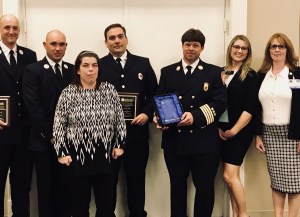
The Seabrook Fire Department was recently recognized by Portsmouth Regional Hospital for outstanding EMS Services, which highlighted a call they answered that saved a life. Chief Edwards described the call.
“The crew responded to a patient who had complained of not feeling good and was found unresponsive. When the crew arrived CPR was in progress. Crew took over CPR and Defibrillated the Patient. The Patient heart rhythm showed Ventricular Fibrillation or V-Fib with agonal respirations. So the crew continued CPR. Patient was nasally intubated and had assistance breathing with a Bag Valve Mask or BVM. Patient Airway was suctioned and Patient was transported to Seabrook ED.”
The Board of Selectmen were joined by Portsmouth Regional Hospital at their last meeting to recognize the outstanding work of Seabrook EMS, with a Board Certificate presented to the Department. The Board of Selectmen extend their congratulations and thanks to the Seabrook Fire Department, and to the Firefighters who participated in the call.
The six Firefighters were Robert Baker, Troy Coleman, Richard Curtis, Barry Sargent. Christopher Tilley, and Russell Eaton Jr.
The Seabrook 250th Anniversary Celebration kicked off Sunday June 3, 2018 with a ceremony at the Old South Meetinghouse. Many thanks to the Seabrook Historic Society, the Seabrook Anniversary Committee, and the Seabrook Board of Selectmen for all of their work and support. Special thanks to Ollie Carter for his work, and to the legislative delegation for their help and support.
On May 17th 2018 the New Hampshire Department of Environmental Services presented the Town of Seabrook Water Department and the Rockingham Planning Commission the 2018 Source Protection Award for pioneering work to protect groundwater resources in New Hampshire.
The Town of Seabrook requested that DES reclassify the wellhead protection area that encompasses the entirety of the of the town owned municipal public water supply wells to GAA from unclassified. This was a regional effort, with support coming from the Select Boards of Seabrook, Hampton Falls, and South Hampton. The initiative from all three communities authorized municipal staff to participate in the best management inspection program for the areas of the wellhead protection areas that are within their town borders. This action will increase protection for 4056 acres of the total 7039 acres in the wellhead protection area for the Town of Seabrook’s water wells.
This project was conceived back in 2014 when the Planning Board sub-committee had been examining the ramifications of future development in the Route 107 corridor. With the approval of the Seabrook Board of Selectmen the Water Department and the Rockingham Planning Commission started the application process with DES. This process entailed participation in public hearings, and Board of Selectmen meetings, in Seabrook, Hampton Falls, and South Hampton. The DES approved this application on September 20, 2017, with the Town of Seabrook water wells reclassified to GAA status from that date forward.
Water Superintendent Curtis Slayton has recommended a special commendation, and recognition, for Water Department Chief Operator/Primary Operator George Eaton, who has been instrumental in implementing the Best Management Practice inspections for the Town of Seabrook. These vital inspections play a key role in protecting the source water in the wellhead protection area which extends into four towns. This is a huge project for the Seabrook Water Department, and will help ensure the delivery of safe, clean water to the residents of Seabrook, and our neighboring communities. The Seabrook Water Department, and the Board of Selectmen, recognize, and deeply appreciates the prominent role played by the Rockingham Planning Commission in securing this project.
The Board of Selectmen recognized the Water Department at the June 4, 2018 meeting.
This John Dean book should be very interesting to those that remain fascinated by Watergate, or Richard Nixon. I watched all of the Dean testimony before the Watergate Committee, and I was amazed, as a youngster, at his command of detail. That same command is exhibited here, with Dean having access to the library of Watergate tapes that are now part of the public record. Dean’s testimony before the Ervin Committee, as detailed as it was, was made without the benefit of review of the tapes made by President Nixon. This book allows Dean, a participant in the acts of conspiracy and obstruction of justice, to review the audio tapes, and create a truly impressive record of how the Watergate matter unfolded, using those tapes to let us hear directly from the participants, taking us from the start of the cover-up to the end.
The book brings us some of the major figures of the Nixon Administration, and some of the lesser lights that played an outsized role in the Watergate scandal. For those that might not be familiar with those players the book may not be the best place to start a study of Watergate, but you will get here eventually. From Jeb Magruder all the way to John Mitchell the story has a large cast of individuals that were wrapped up in the Watergate scandal, and other acts of the Nixon Administration, that toppled the President.
Richard Nixon truly was, if nothing else, a ruthless and brilliant politician, who was on every national ticket from 1952-1972, with the exception of 1964. The White House recordings show us how Nixon tried to “manage” the Watergate affair from the start, and truly botched it badly, despite his usually strong political instincts. Dean takes us along on a calendar ride, examining the White House political response to the initial break in at the Watergate, and then follows the calendar expertly, showing us how this initial political brush fire turned into a conflagration. As time passes, whether it be Watergate or other matters, our memory tends to fade, with the motivations of those involved part of that memory loss. Dean gives us not only a good review of the timeline but a pretty good narrative on the motivations of the individuals we get to hear through President Nixon’s taping system.
So what happened to Nixon’s usually solid political instincts, and how did he manage to get himself directly caught up in the conspiracy to obstruct justice? As badly as Nixon handled the matter the tapes show us a President who almost made it out of this mess wounded but intact. Without the tapes Nixon might have been able to weather the storm. Nixon started by looking to limit the fall-out to the five burglars and E. Howard Hunt and G. Gordon Liddy, hoping to get guilty pleas and light sentences that would contain the scandal there. But the connection between these 7, and the White House through the Nixon re-elect committee, and the direct connection between Hunt and Chief of Staff Bob Haldeman, and Presidential Domestic Advisor John Ehrlichman, and Presidential “troubleshooter” Charles Colson, presented some real political problems for the Nixon White House. These problems were not limited to the Watergate matter, which was the true crux of Nixon’s problem. A real investigation of Watergate would likely uncover other, unrelated to Watergate illegalities that might come to light and that were directly tied to the Nixon White House, and likely to Nixon himself. That fact, more than Nixon’s direct handling of Watergate, in my view, led to the unraveling of the cover up. As Nixon plugged one hole in the dike other leaks sprung forward, eventually overwhelming Nixon and leading to disaster for his presidency. Bob Haldeman saw the risk after the break in, on June 20, 1972: “Haldeman, however, did record in his diary that evening: ‘I had a long meeting with Ehrlichman and Mitchell. We added Kleindienst for a little while and John Dean for quite a while. The conclusion was that we’ve got to hope the FBI doesn’t go beyond what is necessary in developing evidence and that we can keep a lid on that, as well as keeping all the characters involved from getting carried away with any unnecessary testimony.’ “
Dean, John “The Nixon Defense” Page 19
As the White House and the Nixon re-elect Committee both scrambled to find out what the exposure was they came into information that would likely have put former Attorney General (and head of the Nixon re-elect Committee) John Mitchell at serious risk. Activities related to the break in at the office of Daniel Ellsberg’s (the man who released the Pentagon Papers) doctor presented a real problem. The tangled web of illegal activities directed by the Nixon Administration made localizing the Watergate break in to the actual burglars next to impossible. Nixon’s desire to protect an old associate, and the former Attorney General of the United States, John Mitchell, from legal peril contributed greatly to the eventual collapse of the cover-up.
Beyond the direct connection to the White House the investigators were able to trace the money, connecting the dots on money found back to the Nixon re-elect Committee, and eventually back to major players in the Nixon money operation. Haldeman outlined the problem for Nixon on June 23, 1972:
“ ‘Now on the investigation, you know, the Democratic break in thing,” Haldeman began, ‘we’re back to the problem area, because the FBI is not under control, because Gray doesn’t exactly know how to control them, and their investigation is now leading into some productive areas.’ More specifically, he explained, the FBI had ‘been able to trace the money ‘ found on the burglars to the bank that issued the new hundred-dollar bills , although not to the individuals to whom the bills had been given. ‘And, and it goes in some directions we don’t want it to go.’”
Dean, John “The Nixon Defense” Page 56
Acting FBI Director L. Patrick Gray, appointed on an interim basis to replace J. Edgar Hoover, proved to be a disaster in every respect as FBI Director. When Nixon reluctantly, at a later point, sent Gray up for confirmation as Director the Senate hearing on that appointment turned into a major disaster for Nixon, as well as for Gray. The Nixon team, realizing that matters were indeed getting out of hand, concocted the idea to use the CIA to “warn off” the FBI, and get them to limit, or stop the investigation. “Haldeman then continued with his recommendation regarding the out-of-control FBI: ‘That the way to handle this now is for us to have [CIA deputy director Vernon] Walters call Pat Gray and just say, stay the hell out of this business here, we don’t want you to go any further on it.’”
Dean, John “The Nixon Defense” Page 56
Nixon bought in, and so directed Haldeman, on June 23 in advance of a Haldeman meeting with Vernon Walters and Richard Helms of the CIA:
“‘I’d say, the primary reason, you’ve got to cut it the hell off, I just don’t think , ah, it would be very bad to have this fellow Hunt, you know, he knows too damn much. And he was involved [in the Watergate break-in], we happen to know that. And if it gets out, the whole, this is all involved in the Cuban thing, it’s a fiasco, and it’s going to make the FBI’-he had misspoken and corrected himself-‘the CIA look bad, it’s going to make Hunt look bad, and it’s likely to blow the whole Bay of Pigs thing, which we think would be very unfortunate for the CIA, and for the country at this time, and for American foreign policy. And he’s just got to tell them, lay off.’”
Dean, John “The Nixon Defense” Page 61
That tape would eventually be considered the Nixon “smoking gun” tape which would, when released, finish him off politically. Nixon’s involvement in the cover-up was clear, and it also involved knowledge of perjured testimony, suborning additional perjury, and approval of the payment of hush money to the original Watergate defendants. This book brings us much more than an indictment of Nixon. Dean shows us Nixon and his staff trying to their best to seal this off before it crippled them, and largely failing each step of the way. It really is a fascinating story, with Dean showing, in my view, a bit of sympathy for Nixon. He never whitewashes Nixon’s actions, but shows that Nixon really was trying to ascertain some of the particulars with regards to people close to him. What was Mitchell’s level of knowledge, in advance, of the Watergate break in? Who authorized what, and when? Dean speculates, and shows fairly convincingly, that Nixon, for all his faults, was pretty poorly served by his closest associates, including Haldeman, but especially Ehrlichman and Mitchell. Plenty of blame to go around, but Nixon had to weed his way through some internal evasions, and outright lies, from top staff, who came to realize the legal jeopardy that they were in. As Nixon came to the same realization he continued to try to contain the matter, but as his co-conspirators fled the ship, (John Dean initially, but many others later) he resorted to the same types of internal evasions, and outright lies, that had helped to get him into the mess. Dean, realizing before the others that the group, including Nixon, was likely guilty of a conspiracy to obstruct justice, warned Nixon in his “cancer on the Presidency” talk of March 21, 1973 that serious legal problems lay ahead for the key staff, including Haldeman, Ehrlichman, Mitchell, and Dean himself. It would not be possible, in light of that tape, to make the case that Nixon did not understand the conspiracy to obstruct justice that was ongoing.
Did I learn anything new from the Dean book? I did in fact find out that the Nixon White House, through the President himself, had a pretty good feel for what the Justice Department was doing by Presidential talks with AAG Henry Peterson, and with AG Richard Kleindienst. Neither man was charged with wrongdoing for those conversations, with Peterson eventually ceding control of the investigation to Special Prosecutor Archibald Cox. Nixon was not shy about asking, and without question received information that he should not have had from both Peterson and Kleindienst. I was a little surprised by the extent of the involvement of Haldeman and Ehrlichman in the operational side of the “intelligence” operations mounted by the Administration. I never realized the extent to which they had participated, especially Ehrlichman. They had greater legal exposure than the conspiracy to obstruct, which is likely a key reason that Nixon could not go down the “full hang out” road. I also learned that the Nixon Administration, through Haldeman, had a very clear understanding that some of the most damaging press leaks were coming from FBI Associate Director Mark Felt, “Deep Throat” of Woodward and Bernstein fame. Dean paints Felt as eager to undermine Acting Director Gray, who was not considered to be a true FBI man, as well as ambitious for the FBI Director’s job. In today’s world Felt might be characterized as part of the “Deep State.” If Nixon had survived politically Felt would not have been in a very good position.
The times were different but some important lessons can be taken from the Watergate scandal. Having the President “interfere” at a Justice Department charged with investigating crimes committed by members of his Administration, with the President possibly being a subject of investigation, is a pretty bad idea. When the facts came to light on Nixon’s actions major figures in the GOP decided that the country was more important than the Party, and made it clear to Nixon that they could not support his continuing in office. When Nixon fired the Special Prosecutor Archibald Cox it was Republican Attorney General Eliot Richardson, and then his Deputy William Ruckelshaus that refused his order, and created a political firestorm by themselves being fired by Nixon. Nixon always considered his actions “fighting back” politically, and consistently pointed to the actions of Democratic Presidents, who he felt had committed similar illegalities. The “What Aboutism” argument is not a recent creation. But as Nixon came to find out obstructing justice is not the same as political infighting. For those looking to learn more about Watergate I highly recommend this book.
The Town of Seabrook held the Memorial Day commemoration and parade on Sunday May 27, 2018. The Board of Selectmen would like to thank the DPW for all of their work, as well as Seabrook Fire and Seabrook Police for all of their work as well. Some special thanks to Katie Duffey, our Recreation Director, who put in a lot of work to put the parade together and make the day such a success. A big thank you to the Raymond Walton Legion Post 70 for all of their work, and for their hospitality after the Parade. We remember those that made the ultimate sacrifice in defense of freedom, and in defense of our great country.
I very much enjoyed “The Death of Expertise” by Tom Nichols. (Is that enjoyment a case of “confirmation bias?”) Nichols is a center-right Republican who wrote a piece for the Federalist back in 2014 dealing with the same subject http://thefederalist.com/2014/01/17/t…
If you have witnessed, or worse yet, participated in a “discussion” on affairs of state via social media you likely understand Nichols subject matter without even reading the book. Have a reasoned discussion where even in the event of disagreement you can agree on a set of underlying “facts?” Not likely. More likely is that you will encounter someone with no knowledge of, or understanding, of the subject of the discussion. But that person will hold forth as someone with vast knowledge of the subject matter, even insulting those with differing viewpoints, often in harsh terms. There is more than a little irony when you have a “low information individual” decrying the participation of “low information voters” in the political system. Nichols nails that down pretty cleanly.
“In modern America, policy debates sound increasingly like fights between groups of ill-informed people who all manage to be wrong at the same time. Those political leaders who manage to be smarter than the public (and there seem to be fewer of those lately) wade into these donnybrooks and contradict their constituents at their own peril. There are many examples of these brawls among what pundits and analysts gently refer to now as “low-information voters.” Whether about science or policy, however, they all share the same disturbing characteristic: a solipsistic and thin-skinned insistence that every opinion be treated as truth. Americans no longer distinguish the phrase “you’re wrong” from the phrase “you’re stupid.” To disagree is to disrespect. To correct another is to insult. And to refuse to acknowledge all views as worthy of consideration, no matter how fantastic or inane they are, is to be closed-minded.”
Nichols, Tom. The Death of Expertise: The Campaign Against Established Knowledge and Why it Matters (p. 25). Oxford University Press. Kindle Edition.
Of course the “death of expertise” is not limited to politics. Nichols skewers the people trying to offer guidance on medical matters, such as the anti-vaccine crowd. It is not just the advice, but more importantly that in todays atmosphere of “anti-intellectualism” that such advice is given credence by a pretty large group of Americans. Nichols drives home this point in his Federalist piece.
“This isn’t just about politics, which would be bad enough. No, it’s worse than that: the perverse effect of the death of expertise is that without real experts, everyone is an expert on everything. To take but one horrifying example, we live today in an advanced post-industrial country that is now fighting a resurgence of whooping cough — a scourge nearly eliminated a century ago — merely because otherwise intelligent people have been second-guessing their doctors and refusing to vaccinate their kids after reading stuff written by people who know exactly zip about medicine. (Yes, I mean people like Jenny McCarthy.)”
Nichols, Tom. The Death of Expertise The Federalist. January 17, 2014.
Nichols covers a lot of ground, and after reading the book you are likely to be substantially more pessimistic about the future. Before I read the book I looked at some of the reviews, some of which were critical of Nichols for not producing a more “scientific” look at the problems he identifies. I understood, but I think the book highlights issues that are corroding our democracy, and need to be talked about. Nichols is not putting forward empirical data, but rather a point of view. Without a doubt some of Nichols observations are not “politely” put forward, but they are, in many instances, from my perspective, absolutely correct. While my observation above about the tenor of social media “debates” is obviously anecdotal I do not believe that the nasty and tribal nature of the dialogue online can be denied. Nichols brings forward many observations that highlight the rejection of rationality in political discourse.
“Public debate over almost everything devolves into trench warfare, in which the most important goal is to establish that the other person is wrong. Sensible differences of opinion deteriorate into a bad high school debate in which the objective is to win and facts are deployed like checkers on a board—none of this rises to the level of chess—mostly to knock out other facts. Like the customer in Monty Python’s legendary “Argument Clinic” sketch, we find ourselves merely gainsaying whatever the other person said last. (“This isn’t an argument,” the angry customer tells the professional arguer. “Yes, it is,” he responds. “No, it isn’t! It’s just contradiction!” “No, it isn’t.” “Yes, it is!”)”
Nichols, Tom. The Death of Expertise: The Campaign Against Established Knowledge and Why it Matters (p. 41). Oxford University Press. Kindle Edition.
“All of this interaction is doing little to loosen the attachment of laypeople to misinformation. In fact, the problem may be worse than we think. When confronted by hard evidence that they’re wrong, some people will simply double-down on their original assertion rather than accept their error. This is the “backfire effect,” in which people redouble their efforts to keep their own internal narrative consistent, no matter how clear the indications that they’re wrong.”
Nichols, Tom. The Death of Expertise: The Campaign Against Established Knowledge and Why it Matters (p. 131). Oxford University Press. Kindle Edition.
Nichols believes that the “death of expertise” has marginalized so called experts, giving rise to a tower of babel on important issues. While he takes pains to qualify his desire for “experts” to be given the deference and respect that their expertise warrants, and acknowledges that the experts have proven disastrously wrong on many occasions his presentation can be grating, and at times come off as more of a rant. Despite that mild criticism I think he makes some prescient points, and brings some “reason” to the discussion.
Maybe past discussions were this acrimonious, and we are all just exaggerating the “death of expertise” and the aversion to rationality in politics. I think not, but anti-intellectualism has always been a strong strain in American life. Although Nichols covers expert errors the disastrous results in Vietnam and the epic mistake made in invading Iraq have contributed greatly to popular distrust of “experts.”
The Iraq war, for me, highlights the role tribalism plays in the positions that people take. I have many friends that supported the war in the strongest of terms, even after the disaster was apparent. Without any knowledge of the region, the history, or the religious issues involved I received many lectures from these people about the war being the “right thing to do,” and impugning the patriotism of those who opposed it. Many of those same people now support President Trump, and have, within the warm confines of the Trump criticism of President Bush and the Iraq invasion, changed their position on the war. Many have expressed shock at, and blamed President Obama for, the expansion of Iranian influence in Iraq, forgetting that they laughed off the potential for Iran expanding its regional influence as a result of the U.S. invasion. As long as tribalism trumps rationality those discussions are difficult, and in many cases simply not worth having.
Nichols expanded the original federalist article to create this book, and though you may take issue with how he presents, and with some of the arguments he makes, I recommend the book. Nichols not only brings forward some interesting concepts, but does so in a very entertaining fashion. I have to say that while I disagree with many of his social media observations I follow his twitter feed @radiofreetom and enjoy that very much as well.
At the May 7, 2018 meeting I presented the Board of Selectmen with a financial report in advance of the budget season, pulling together Seabrook’s disparate financial data into one report. As part of that report I have also submitted the 2017 water report, as well as the 2017 sewer report. Those reports highlight the growing amount of the “tax subsidy” flowing from taxpayers to ratepayers. The 2017 report on the ambulance revolving fund, as well as two additional reports (Appendix A and B) are also below. I have included an executive summary, which is also reprinted in full below.
Seabrook Financial Report
Executive Summary
The report submitted today will commence the conversation, and help to clarify some of the underlying issues, on Seabrook’s financial future. The financial data was compiled with the assistance of Carrie Fowler, our Finance Manager, and Angie Silva, our Assessor. The report looks at what factors go into setting our municipal tax rate, with the data showing us where we get our tax dollars, and where those tax dollars go. The report shows us the trend lines involved, with the goal of assisting our policy makers on the Board of Selectmen and the Budget Committee.
What are some of the important trends shown in the report? We see that the total dollars raised through taxation by the Town of Seabrook, in the measured period, (2014-2017) have grown by slightly over $2 million, a rate of growth of less than 2%. That makes it difficult to make the case that Seabrook has a “spending” problem. The report shows the impact that the drop in NextEra tax revenue has had, and how that drop has fundamentally changed the percentages paid by the different classes of taxpayers. In 2016, for the first time since the Seabrook Station opened, the “residential” class of taxpayers paid more in taxes than NextEra. That trend line has accelerated since then. As this trend continues it will present major policy challenges for the Town. Another trend that the report highlights is the importance of the commercial/industrial/other utility category, which has grown in the measured period by over $2 million, bringing that number to over $9 million annually. This category will likely pass NextEra as a tax contributor in the next three to five years, and shows that the idea that Seabrook could do without this tax class is misplaced. The new growth numbers are examined, and show that $2 million in new tax revenues have been derived in the measured period, and that “new growth” has been vital, financially, to Seabrook.
The report also examines where our tax dollars are going. It shows that the “town” portion of the overall dollars raised has declined slightly, with the local school portion rising correspondingly. It would appear, based on that trend, that the schools will pass the Town, budget wise, within three years. The four year increase in the total tax levy for the Town is $322,711, which is a rate of increase of less than 1/2 of a percent a year. The report looks at some of the reasons for that number, including the history of the “unexpended fund balance,” which was driven to over $9 million in 2016, allowing the Board to strategically deploy some of those resources to hold down the tax levy. The drop in NextEra payments is also reflected in that number. It is further evidence that the issues facing us have less to do with a “spending” problem than with a “redistribution” of the relative tax burden.
As we look at some of the key numbers in the report each measured year looks at “local revenues,” and points out that the dollars raised through “local revenues” reduces the need for money to be raised through taxation. Appended to the main report are the two 2017 reports detailing the subsidy from taxpayers to the sewer fund, and the water fund. These two reports show that the subsidy amounts to over $1.8 million without the inclusion of capital. If capital is included that number will exceed $2 million. Operationally that is 8.2% of the operating (non-capital) budget, and a major issue facing us going forward.
The report looks at employee health care costs, which have been relatively stable over the course of the measured period, albeit at a major percentage of the overall budget. Those costs are over 15% of our operating budget, and the report looks at what a reduction in that number would mean for Seabrook’s budget. The report looks at this number in combination with the above mentioned water and sewer subsidy, recognizing that in combination those two items constitute 23% of the operating budget, and growing. The problem that creates, budget wise, is obvious. These two items are crowding out other necessary spending, and if the trajectory continues the strain will only become more substantial. The report looks at the 2017 tax rate, and determines that without a water and sewer subsidy the tax rate increase would have gone from the actual 9.9% to 2%.
The policy issues facing the governing body and the Budget Committee are discussed in general terms. What are they?
Should services be maintained at current levels?
If services are to be maintained should they be delivered in the same fashion?
If service cuts are to be made where should they come from?
Should steps be taken to end the subsidy from taxpayers to water and sewer ratepayers?
How should we deal with the trend of lower overall payments from NextEra?
This report is not the end, but rather the beginning of the many policy issues facing Seabrook. Hopefully it will provide some tools for our policy makers as this process begins.
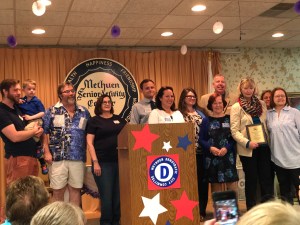
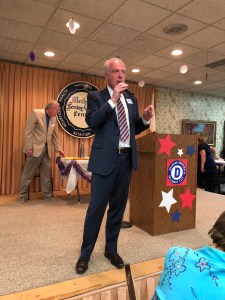
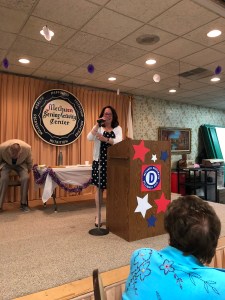
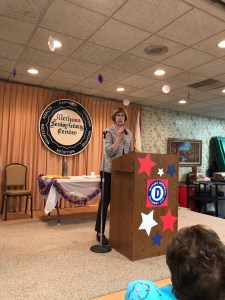
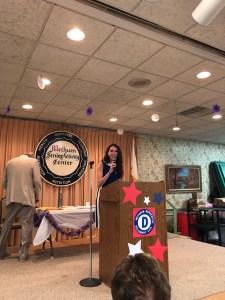
Great turnout at the 2018 Methuen Democratic Town Committee breakfast, where over 300 Democrats gathered to hear candidates speak, recognize Christine Metzmaekers as Democrat of the Year, and conduct a straw poll for some of the exciting races we have coming up later this year. Congrats to Christine, a great Democrat who really deserved the recognition. Thanks to our Chair Jessica Finocchiaro for all of her hard work in putting it together. Thanks to all the Committee members who worked so hard to make the breakfast a success. The poll results are below. Thanks to all the candidates who took the time to attend the breakfast and offer all of us some perspective on their candidacies.
On Tuesday April 24, 2018 Mayor James P. Jajuga gave his first State of the City Address as Mayor, at Mann’s Orchard. The video of his remarks is below.










 Bill Manzi.com