Seabrook Reaches Tax Agreement With NextEra on Seabrook Station

The Seabrook Board of Selectmen yesterday announced that a three year tax agreement with NextEra, the owner of the Seabrook Station nuclear plant, had been achieved. The agreement covers FY 2018-2019-2020, and calls for NextEra to make tax payments of $36 million to Seabrook over that three year period. The payments will be annualized at $12 million. This agreement follows the last two year agreement that covered 2016-2017 that was worth $24.75 million. The assessment for Seabrook Station for FY 2018 was $849,858,400.

The national nuclear power industry has had rough times over the past few years. There have been multiple plant closures that have already occurred, with as many as nine plant closures scheduled for the next few years, including the NextEra owned Duane Arnold plant in Iowa. The challenges in that industry translate to difficult negotiations for the Board of Selectmen. They should be commended for their work here.

The agreement comes after the close of the fiscal cycle of 2018. In that period the Town of Seabrook assessed the plant at a value that resulted in a tax bill of $12,500,000. Although the Board was not required to abate that amount (the $500,000 could have been offset against the next two years of tax payments) they have determined, for legal and strategic reasons, to abate the FY 2018 over-payment.

This agreement was the result of long hours and much hard work by the Seabrook Board of Selectmen. Town Assessor Angela Silva was instrumental in reaching this agreement. Our thanks to NextEra, who worked diligently with the Town to reach this agreement.

Press coverage of Seabrook/NextEra tax agreement.

Posted in Seabrook | Tagged , , , , | Leave a comment

No Sure Things in 2020. (Or Go Mid-West Young Man)

Is it too early to start looking at the 2020 Electoral College Map? In light of some of the predictions I am reading from both Democrats and Republicans I think a good look at the map might sober up many of the propagandists from both sides.

The key to the Trump victory in 2016, in my opinion, was the win in PA, WI, and MI. The so called Blue Wall crumbled and enabled Trump to claim 306 electoral votes, to 232 for Clinton. Of course there were other factors, including the Clinton loss of FLA and OH, but more on that in a bit.

In Pennsylvania Trump’s 2016 win was narrow, with a margin of 1.2%, getting him the big 20 electoral votes of the state. Trump also had more votes in PA than Clinton and Jill Stein combined, so the Trump win, while narrow, was convincing (shocking?) enough. In Wisconsin (10 electoral votes) the Trump margin was under 1% (.77%), and the combined Clinton/Stein vote exceeded the Trump vote by a very narrow amount (8300 or so votes out of more than 2,900,000 cast.) In Michigan (16 electoral votes) the Trump margin was even smaller, again less than 1% (.23%) and the combined Clinton/Stein vote exceeded the Trump number by 40,759 out of about 4.8 million cast.

There will be substantially more sophisticated looks at the map than mine, but there are some things I believe today that, if true, make predictions of an easy win by either side more propaganda than science. As a Democrat I look at the states of Florida and Ohio (especially Ohio) and just do not believe that the Dems can win there. If that is true then the battle shifts to the three states highlighted above. And if that is indeed the battleground for 2020 then despite the outstanding mid-term results for Democrats a Trump re-election is distinctly possible.

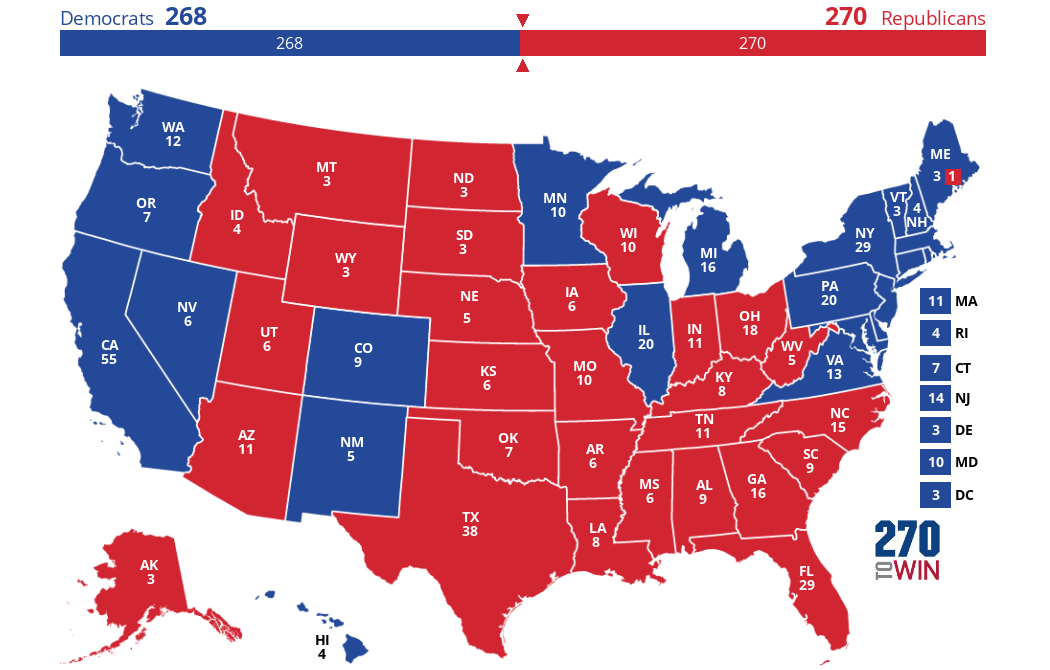
Let’s look at the first map, which shows the difficulties involved in this race. This map has Trump losing two of the three states from above (PA and MI)but winning Wisconsin. If he holds everywhere else where he won in 2016 he ekes out a victory. These three states will not necessarily march in lockstep, and as we can see two out of three (all else being equal) will not do it for the Democrats. The current polling has Joe Biden beating Trump in all three states, but at this stage those numbers do not mean much.


Click the map to create your own at 270toWin.com

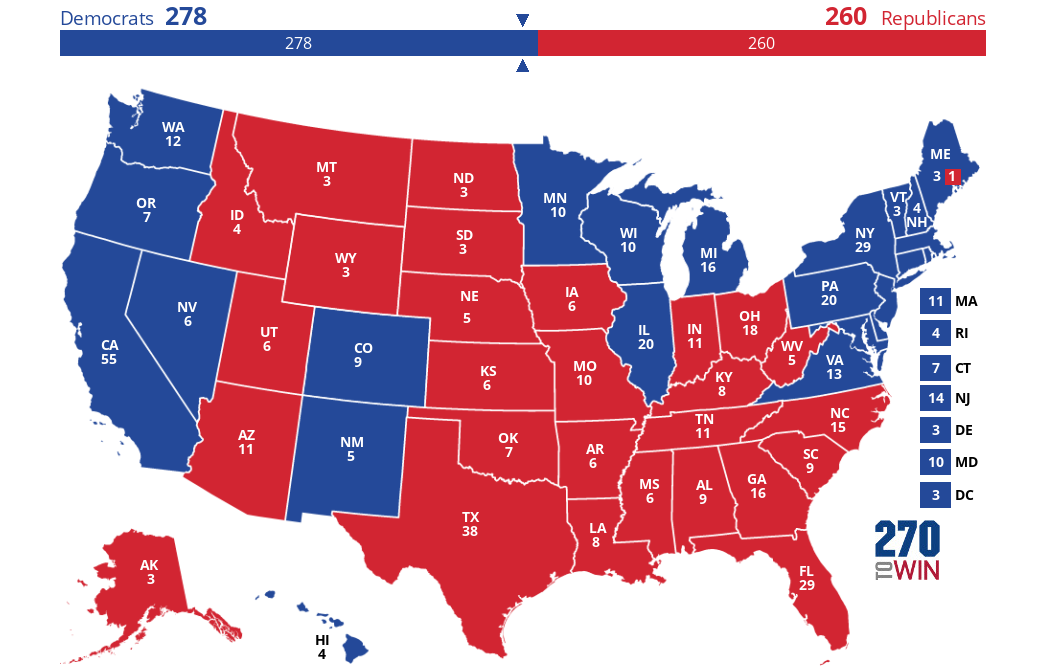
Let us look at the map with the Democrats running the table on the three states and winning the Electoral College with 278 votes. Even in that scenario Trump still is sitting at 260, and looking to pick off New Hampshire, where the Clinton margin of victory was under 1% (.4%), and Nevada, where Clinton had a margin of 2.4%. If he lost all three of the target states but flipped New Hampshire and Nevada he wins, with exactly 270 electoral votes.


Click the map to create your own at 270toWin.com

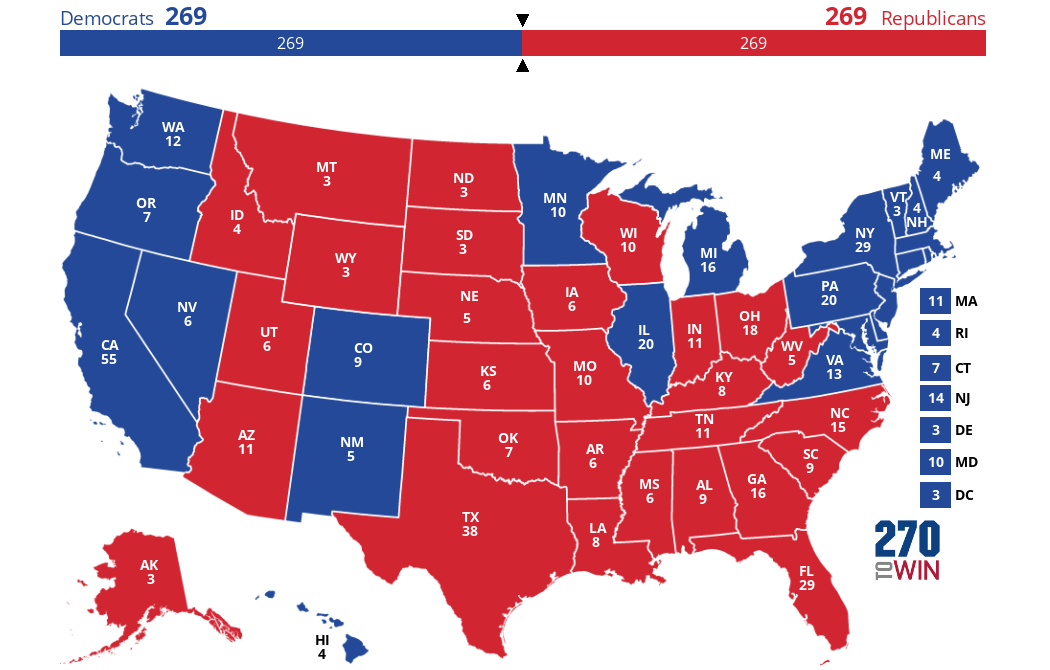
And now let us look at the nightmare scenario, an offshoot of the top map. Under the original scenario the Democrats manage to win both Michigan and Pennsylvania but Trump wins Wisconsin and wins the electoral college 270-268. We modify that by having the Democrats take the second Congressional District in Maine, which they lost in 2016. That would be worth one electoral vote, and would throw the election to the House of Representatives.


Click the map to create your own at 270toWin.com

My assumptions will likely be dismissed by some. Writing off Florida for the Democrats may be harsh, but in a big mid term surge for Democrats they could not beat a truly sub-par Republican candidate for Governor in 2018. Ohio, to me, just seems out of reach. Election results seem to bear that out. Clinton had some dreams of stretching the map a bit, but those ambitions should be secondary, in 2020, to accomplishing what is clearly achievable. Regaining PA, MI, and WI for the Democrats will make a Trump re-election very difficult. I would think that heavy Democratic resources will be poured into those states. You can count on Trump pouring it on in those three states, with presence and finance, and his current low poll numbers are no guarantee of victory for the Democrats. He will bring substantial campaign activity to New Hampshire, Nevada, and Minnesota (where the Clinton margin was 1.5%), looking to steal one of those.

If somebody tells you that the 2020 election is a “lock” for either party tell them that they need to read an electoral map. The 2020 election cycle is going to be one tough slog.

Posted in Electoral Map | Tagged , | Leave a comment

Seabrook Goes Paperless for Board of Selectmen Meetings

The Town of Seabrook has gone paperless for Board of Selectmen meetings, allowing us to transmit data, including backup data, to the Board of Selectmen more efficiently, with significantly less staff time, paper, and copying costs for the Town. With the price of paper rising, and the Town already deploying tablets within our asset management program, we had the ability to provide tablets for meeting access to the materials (agenda and backup) for the Board. This access is not limited to the tablets, which primarily reside in Town Hall. Access to the intranet is available through desktops and laptops as well, giving the Board an ability to view agendas, past and present, by accessing the site through their own computers.

While we looked at several alternatives as we approached this issue, including agenda software, we opted to build an intranet with password access, and multiple layers to it, allowing us to scale the project to other Boards. We currently have tabs for Planning and Zoning, and will have full employee access for information postings (internal bulletin board) very soon.

While access to the current agenda is the main purpose of this effort we felt it important to facilitate Board access to prior meetings, including backup, in order to allow research, to be able to retrieve older documents without an endless paper chase, and to be able to view the video of the meeting. We have connected the intranet with our meeting video retention software, providing a direct link on the agenda page to the meeting video. Chasing video requests internally is now a thing of the past.

My thanks to IT Director Brian Murphy, who worked long and hard, and skillfully, on this project. My thanks to Deputy Town Manager Kelly O’Connor, who kept the work flow on schedule, and thanks also to Project Clerk Kelsey Mae Boscoe, who is now setting up the online agendas and backup. Great team effort.

An especially big thank you to the Board of Selectmen who really pushed for the project, and looked after it frequently. They recognized the financial benefits to the Town, and were invested heavily in the project.

The link to the media coverage here.

Posted in Seabrook, Technology Beat | Tagged , | Leave a comment

A look at “The End of the Party: The Rise and Fall of New Labour” by Andrew Rawnsley

The End of the Party: The Rise and Fall of New LabourThe End of the Party: The Rise and Fall of New Labour by Andrew Rawnsley
My rating: 5 of 5 stars

A terrific, and detailed book, about the second and third terms of “New Labour” led by Tony Blair, and then by Gordon Brown. This book is a follow-up to the author’s “Servants of the People” look at the first term of Tony Blair, Gordon Brown, Peter Mandelson, and “New Labour.”

Like the first book the central theme remains the constant political warfare between Tony Blair and Gordon Brown, and how that impacted the governing of the Labor government. Of course the events they were dealing with in the second and third terms included Blair’s politically misguided Iraq war decisions, which the author covers in detail. That detail is not kind to Prime Minister Blair, nor should it be. Gordon Brown does not fare much better, and is shown in the worst light, both as a Chancellor constantly trying to push Blair towards the exit, and as the Prime Minister when he finally got Blair to go.

As British political history goes this book is invaluable. Tony Blair led Labour to three general election victories, and although Brown was often credited as the political mastermind of those victories it is quite apparent that Blair should have gotten a much larger share of the credit. When Blair exited the entire apparatus fell apart, although his Iraq decision played some role in the ultimate demise of “New Labour.” The constant battles between Blair and Brown were in many cases centered on policy, but the author shows us a conniving Brown using policy to try to try to undercut his own Prime Minister. Fairly or not the view has always been that Blair was more flash and spin than substance and detail, but I never bought that line entirely. Without a doubt Blair used media to hype, and yes, to spin, press coverage. But he knew his brief, and showed that knowledge during Prime Minister’s Questions, where he frequently made short work of the Tory Leader. The author sticks to that theme here, pointing to the Blair tendency to gloss over detail while embracing “vision.” It was observed by Sir Robin Butler that:

“the attitude of Tony Blair and New Labour was that it was their job to have the concept. They would define the New Jerusalem. It was the civil service’s job to get there. So if one failed to achieve everything that the Government wanted, this was somehow the fault of the technicians, the civil service. Of course, it’s not as simple as that. Objectives require resources, organisations, discussions about capacity.”

Rawnsley, Andrew. The End of the Party (p. 288). Penguin Books Ltd. Kindle Edition.

“What Blair lacked was a sustained interest in the mechanics of delivery. ‘He latched on to issues,’ observes Sir Stephen Wall. ‘But he didn’t have a really determined follow-through.’49 Margaret Jay coined a phrase for the boredom in Blair’s eyes when he was forced to listen to the ‘nitty gritty’ of policy. She called it ‘the garden look’. His ‘gaze would shift’ and look longingly through the window and out into the back garden of Number 10.”

Rawnsley, Andrew. The End of the Party (p. 289). Penguin Books Ltd. Kindle Edition.

The author covers the Iraq debacle at some length, and shows what I have always believed to be Blair’s true motivation: his desire to maintain the “special relationship” with the U.S., at all costs, and to be the “bridge” between Europe and George W. Bush. Blair believed he could influence the Bush Administration Iraq policy by proximity to the President, but his hopes in that regard were dashed by Bush (and Cheney and Rumsfeld.) The power in that relationship was obviously disproportionately in Bush’s favor, but the author speculates that Bush, as always, was underestimated politically by the British.

“Bush was a politician of some skill. This was rarely noticed by most people in Europe and wholly forgotten later when Bush became such a discredited figure. Yet it was true. Blair was once asked by a colleague: ‘What do you see in Bush?’ Blair responded: ‘He’s got charm and peasant cunning.’ This was a potent combination when allied with the most powerful office in the world. ‘I think Bush genuinely liked Blair,’ says Meyer. ‘But he used Blair.’ ‘Bush was a very artful politician,’ agrees another senior official. ‘Blair thought he was running the relationship, but he was being run.’ At Crawford and subsequently, Bush out-Blaired Blair. The Prime Minister thought he could ride the tiger; he ended up inside its stomach.”

Rawnsley, Andrew. The End of the Party (pp. 95-96). Penguin Books Ltd. Kindle Edition.

Blair’s decisions on Iraq have had an outsized influence on British politics since, impacting the Labor Party and the entire system in ways still felt to this very day. Blair’s record will always have that monumental error on it, but he had plenty of substantial achievements as P.M. as well, including the Good Friday Agreement, which is also still playing a major role in British politics as Brexit negotiations continually founder on the issue of the Irish “backstop.” Blair proved himself, over the longer term, to be a vastly superior politician than Brown, whose tenure as P.M. had some shining moments, but was in many respects a continual train wreck. Rawnsley covers the Brown premiership in sometimes excruciating detail. Brown’s inability to make decisions, and then to make bad decisions when he got around to execution, is covered very well. Brown’s decision making process was neatly summed up by political observer Sue Cameron, who said:

“When John Major was in Number 10 and there was a big decision to be taken, he would order papers and he would read through them, often quite late into the night. The next morning, he’d make a decision. When Blair was in Number 10, he’d tell his civil servants to read the papers and give him a shortlist of options and in the morning he’d make a decision. With Gordon, he sends for the papers, he reads them late into the night and then the next morning he sends for more papers.”

Rawnsley, Andrew. The End of the Party (p. 524). Penguin Books Ltd. Kindle Edition.

Brown ended up losing to a Conservative Leader who seemed to emulate Tony Blair, David Cameron. He seemed, after the fact, and maybe a little before the fact, to become aware of some of his own shortcomings as P.M. Brown was, and is, a very smart man, but he spent a career trying to push Tony Blair out of the P.M. job. When he finally got the crown he found that the job was a little harder than he thought. Some real irony in the fact that Brown, as P.M., had trouble with a Chancellor who would not buy into his program. I am sure Tony Blair found that irony more than a little satisfying. Great book, highly recommended.

View all my reviews

Posted in Books, Brexit | Tagged , , , , | Leave a comment

Happy Birthday Eric Clapton

One of the very greatest musicians of his era, and most certainly at the top of the list of the great rock guitarists, Eric Clapton turns 74 today. He has never been content to stay in one musical spot for very long, and while that has brought some short term disappointment it has brought us a career of outstanding music done his way. His ability to share the stage with some of the greatest talent in music has brought us all endless enjoyment. The below clips are from Clapton reuniting with the great Steve Winwood at a Crossroads festival to bring us what I consider to be the very best version of the Blind Faith masterpiece “Had to Cry Today” as well as Clapton sitting in as a session player in 1967 for Aretha as she does “Good to Me As I Am to You.” Clapton’s wardrobe for that session might have been a bit out there but he showed what he could do sitting in with some very talented musicians. His meeting, and playing with, Duane Allman brought us some music through the Layla sessions that still amazes all these years later. Happy Birthday Slow Hand!

Posted in Music | Tagged | Leave a comment

The Seabrook CIP Seven Year Spending Review

Below I have posted the seven year review of Seabrook Capital Spending, along with a supporting document of tabs that show the basis of the numbers in the main report. This document is designed to show how much we are spending on capital, how we are financing it, and where those capital tax dollars are going. There have been some important changes made, principally the adoption by the Board of Selectmen of capital reserve accounts, which are highlighted in the report. The new annual financial report will be up next. For those that might dismiss the vital importance of annual capital plans please look at the dollars spent over the past seven years. There may not be a more important document produced by localities than the annual CIP.

Seabrook CIP Spending Seven Year Review 2019

Seabrook Capital Report 2019 Tabs

Posted in Seabrook | Tagged , | Leave a comment

The FY 2019 Warrant Articles Tax Impacts

The very preliminary report submitted to the Board of Selectmen on the FY 2019 tax impacts of the approved warrant articles is below. It is important to note that there are longer term tax impacts for Seabrook (bond finance) not covered by this report. A seven year look back at all of Seabrook’s capital spending will be out soon.

Warrant Articles 2019 Board Report

Posted in Seabrook | Tagged , | Leave a comment

The Grand Opening of “The Greyhound Casino & Tavern” in Seabrook

It was an exciting day in Seabrook, as Eureka Gaming opened the Greyhound Casino & Tavern at the site of the old Yankee Greyhound facility they recently purchased. This is the first of many upgrades to come at this location, and occurred a scant 40 plus days after Eureka purchased the site. There is much more to come! Stay tuned for some more exciting economic development news in Seabrook New Hampshire!

Sports Betting Bill passes the New Hampshire House.

Posted in Seabrook | Tagged , , , | Leave a comment

Argo Rescue Vehicle Arrives in Seabrook

The ARGO Rescue vehicle, ordered by the Seabrook Board of Selectmen last year, has arrived in Seabrook. Our first responders are training on this vehicle, which will allow them to reach those in distress that are in difficult to reach areas. While it will be of significant assistance to rescue personnel on Seabrook Beach the vehicle can be deployed town-wide. A big thank you to the D’Allasandro Fund, which financed the purchase, allowing us to increase public safety at no cost to taxpayers.

Press coverage of the Argo purchase.

Posted in Seabrook | Tagged , | Leave a comment

Happy St. Patricks Day. A Review of “Big Fellow-Long Fellow a Joint Biography of Collins and De Valera” by T Ryle Dwyer

Big Fellow, Long Fellow. A Joint Biography of Collins and De Valera: A Joint Biography of Irish politicians Michael Collins and Eamon De ValeraBig Fellow, Long Fellow. A Joint Biography of Collins and De Valera: A Joint Biography of Irish politicians Michael Collins and Eamon De Valera by T. Ryle Dwyer
My rating: 4 of 5 stars

A great bargain on Kindle this book brings us a look at the biographies of Michael Collins and Eamon De Valera, with a focus on their actions between the Easter Rising of 1916 and the assassination of Collins in 1922. This piece of Irish history has been covered extensively, and while this book does an excellent job of covering these two giants of Irish history there was not a lot of “new” material. Many years ago I read the Tim Pat Coogan books on Collins and De Valera, and I still consider his viewpoint on both to be persuasive. This book, in the main, is reflective of the Tim Pat Coogan view, which was largely pro-Collins. The author attempts to compensate a bit with a more balanced look at the end of the book at the legacies of both men, both positive and not so positive.

I bought the book with a clear bias in the direction of Coogan, which is to say I am strongly on the Collins side of this long disagreement. This book did not change that perspective. The author lays out the some of the key elements, on the Irish side, in the Anglo-Irish “war” that Michael Collins had such a prominent role in. Collins, through multiple portfolios in the Dail government (Minister of Finance, Director of Intelligence) and through the Irish Republican Brotherhood, was truly the operational leader of the Irish resistance to British rule in Ireland. Although Collins incurred some criticism for the publicity he received, especially after the split with De Valera, his role as the military leader of the Irish effort cannot be minimized. (The man who won the war) The history of the Irish War of Independence is one of surprising success, with the Collins strategy of guerrilla engagement with the British enabling the Irish to impose a punishing burden on the British for their continued presence in Ireland. The British had a massive operational and resource advantage, but the Collins strategy largely negated that British superiority. While there were clearly some differences in approach in this period between Collins and De Valera those differences were, in my view, on the margins. The book covers this period well, and for those interested gives a fair assessment of the war, and of the relative contributions of each man. It is, of course, what happened when the British sued for peace that creates the controversy that goes on to this day.

Much of the focus, correctly, has been on the London peace conference convened to attempt to come to terms that would end the conflict and bring the Irish some form of independence from Britain. But before that conference the Irish did send a delegation to London to lay the groundwork for the ultimate discussions. That delegation was headed by Eamon De Valera, who had multiple private meetings with British Prime Minister David Lloyd George. The Irish delegation did not include Collins, who was quite put out by his exclusion. De Valera left that conference without the benefit of anything closely resembling terms, refusing to even carry the written British offer with him back to Ireland. Upon his return De Valera jousted with hard liners in the Dail who insisted that any agreement must uphold the principle of an Irish Republic.

“‘We have done our best,’ de Valera replied, ‘and I have never undertaken to do more than my best.’ ‘We have proclaimed a Republic in arms,’ Brugha reminded him. ‘It has been ratified by the votes of the people, and we have sworn to defend it with our lives.’ ‘The oath never conveyed any more to me than to do my best in whatever circumstances might arise.’ ‘You have accepted a position of authority and responsibility in the Government of the Republic,’ Brugha said striking the table with his fist. ‘You will discharge the duties of that office as they have been defined. I do not want ever again to hear anything else from you.’”

Dwyer, T. Ryle. Big Fellow, Long Fellow. A Joint Biography of Collins and De Valera: A Joint Biography of Irish politicians Michael Collins and Eamon De Valera . Gill Books. Kindle Edition.

The book shows multiple examples of De Valera expressing great flexibility on the issues of British acceptance of an Irish Republic, and on the issue of partition. It would make his later actions so much harder to justify.

“Having publicly indicated his willingness to compromise, he went even further in the following days when the Dáil met in private session. In the course of a rather rambling discussion on 22 August, he told deputies to realise that if they were determined to make peace only on the basis of recognition of the Republic, then they were going to be faced with war, except that this time it would be a real war of British reconquest, not just a continuation of limited military coercive measures ‘in support of the civil police’ to force some people to obey the law. In short, he was saying the War of Independence had not been a real war at all.”

Dwyer, T. Ryle. Big Fellow, Long Fellow. A Joint Biography of Collins and De Valera: A Joint Biography of Irish politicians Michael Collins and Eamon De Valera . Gill Books. Kindle Edition.

De Valera’s unwillingness to head the Irish delegation to the London Peace Conference, and his designation of Michael Collins and Arthur Griffith as members has been viewed by so many as a cynical move designed to create distance between himself and what he knew a successful outcome might look like. The discussions and dis-agreements between the Irish and the British on the conference itself were telling, and led to a post treaty argument by Collins that truly put De Valera in an awful light.

“The second point at issue involved recognition of Irish sovereignty. ‘Our nation has formally declared its independence and recognises itself as a sovereign state,’ de Valera wrote, in accepting the initial invitation to the Inverness conference. ‘It is only as the representatives of that State and as its chosen guardians that we have any authority or powers to act on behalf of our people.’ It was the publication of this letter which prompted Lloyd George to cancel the conference.”

Dwyer, T. Ryle. Big Fellow, Long Fellow. A Joint Biography of Collins and De Valera: A Joint Biography of Irish politicians Michael Collins and Eamon De Valera . Gill Books. Kindle Edition.

De Valera, in stating that the Irish recognized themselves as sovereign in advance of the conference, brought on a cancellation by Lloyd George, who was not willing to give that ground up in advance of the conference. De Valera was forced to withdraw that position in order to get the British to agree to the conference, and he did so. That of course led to the Collins observation that:

“‘The communication of September 29th from Lloyd George made it clear that they were going into a conference not on the recognition of the Irish Republic, and I say if we all stood on the recognition of the Irish Republic as a prelude to any conference we could very easily have said so, and there would be no conference,’ Collins later contended. ‘What I want to make clear is that it was the acceptance of the invitation that formed the compromise. I was sent there to form that adaptation, to bear the brunt of it.’”

Dwyer, T. Ryle. Big Fellow, Long Fellow. A Joint Biography of Collins and De Valera: A Joint Biography of Irish politicians Michael Collins and Eamon De Valera . Gill Books. Kindle Edition.

The book covers the cynical ploy of De Valera refusing to head the Irish delegation, the cynical and destructive way that De Valera treated the agreement brought home by the Irish plenipotentiaries from London, his refusal to accept a loss when the Dail accepted the Treaty, and his actions and statements that helped to incite the Irish Civil War, which led to the assassination of Collins. The book honestly gives De Valera’s actions no justification, showing his inconsistencies, his ego driven desire to substitute the ludicrous “Document Number Two” for the Treaty when there was no substantive difference between the two, and his foolhardy rhetoric on the treaty, including his “wade through Irish blood” speech.

The author correctly points out that De Valera ultimately proved Collins point that the Treaty was a “steppingstone” to Irish freedom by entering the Free State Government (years after the Collins assassination) himself, assuming the reigns of a government that he had long maintained was an illegitimate perversion of the goal of an Irish Republic. Collins main argument for the Treaty ultimately was borne out by his most bitter antagonist.

De Valera did some truly outstanding work in moving the “Free State” apparatus to an Irish Republic, and his many years of service to the cause of Irish freedom can never be minimized. He was a political giant with an enormous will, but his failures on the Treaty, and his responsibility for the inciting of the Irish Civil War, shall remain a blight on his record, in my view. Collins, like most political leaders, had a healthy menu of faults, many of which the author covers. His military leadership of the government forces in the civil war has, in many quarters, never been forgiven. But the author correctly points out that some of the “faults” that are attributable to Collins stemmed from his desire to avoid the armed conflict with many of his old comrades that a civil war would bring. His desire to keep reaching for political compromise was cited as a weakness, and perhaps it was. Collins was willing to go the extra mile to try to avoid the conflict that ultimately cost him his life. This book was a fair look at two giants of Ireland, and if you have a desire to learn some of this history then this book is a fine vehicle.

View all my reviews

Posted in Books | Tagged , | Leave a comment