
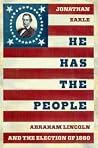
 He Has the People: Abraham Lincoln and the Election of 1860 by Jonathan Earle
My rating: 4 of 5 stars
There are few American presidents about whom more has been written than Abraham Lincoln, which raises an obvious question whenever another Lincoln book appears: what is there left to say? Jonathan Earle answers that question convincingly in He Has the People, an excellent account of the election of 1860 that focuses less on Lincoln the martyred president and more on Lincoln the extraordinarily capable politician who managed to become president in the first place.
That distinction is important. We tend to view Lincoln as the President who saved the Union. Knowing what Lincoln became makes his rise to the presidency appear almost inevitable. It was anything but. In 1859 Lincoln was a former one-term congressman from Illinois who had lost two races for the United States Senate. William Seward of New York was the nationally prominent Republican statesman and the presumptive favorite for the party’s presidential nomination. Lincoln had ambition, ability, and a growing reputation, but his path to the White House remained remarkably narrow.
Earle is particularly good at reconstructing how Lincoln traveled that path. The Making of the President, 1860 might have been a good substitute title. We would wait 100 years for the great Ted White book, and this one, while not as detailed, has a similar objective.
The election of 1860 occurred amid the accelerating collapse of the American political system. The slavery question had destroyed the old compromises, shattered the Whig Party, created the Republican Party, and increasingly divided the Democratic Party along sectional lines. John Brown’s raid on Harpers Ferry in October 1859 intensified an already poisonous political atmosphere. By the time Americans chose a president a year later, the country was approaching a constitutional crisis from which there would be no peaceful escape.
Yet He Has the People is not primarily another book about the coming of the Civil War. It is a book about politics—about nominations, conventions, newspapers, speeches, organizations, personalities, geography, factions, and the difficult business of assembling enough supporters to win an election.
And this is where Lincoln comes alive.
The Lincoln presented by Earle is neither an accidental candidate nor a saint waiting for history to summon him. He is intensely ambitious, politically shrewd, patient, disciplined, and unusually perceptive about both people and political timing. Lincoln understood something that many politicians never learn: a candidate does not always need to be everyone’s first choice. Sometimes it is enough to be the candidate everyone can eventually live with.
That became crucial in confronting Seward.
Lincoln’s supporters understood that defeating the Republican frontrunner required more than enthusiasm. They needed organization, favorable geography, careful management of delegates, and an ability to attract supporters from candidates who could not win themselves. The Republican convention in Chicago becomes one of the most fascinating portions of Earle’s narrative. Lincoln’s victory was not political magic. It was the product of an exceptionally well-run political operation combined with a candidate whose opponents consistently underestimated him.
Lincoln himself carefully maintained the convention-era fiction that candidates stood above the scramble for delegates. He did not. He knew what his supporters were doing, understood the political calculations involved, and wanted very badly to win.
That makes him more interesting, not less admirable.
One of the strengths of the book is Earle’s use of Murat Halstead, the pioneering journalist who followed the campaign and reported extensively on the political conventions. Through Halstead’s observations, the reader gets something close to a ringside seat at a nineteenth-century presidential campaign. These conventions were not the carefully scripted television productions of the modern era. They were loud, uncertain, sometimes chaotic affairs in which delegates actually mattered and nominations could genuinely turn on events inside the hall.
The title itself captures the central argument. Seward possessed many of the advantages normally associated with a winning candidate: national stature, powerful political allies, money, and an impressive organization. Lincoln possessed something ultimately more valuable. He had developed a connection with the Republican electorate, particularly across the rapidly growing West, and his debates with Stephen Douglas and his Cooper Union address had established him as a credible national spokesman for opposition to the expansion of slavery.
Once nominated, Lincoln benefited enormously from the disintegration of his opposition. The Democratic Party split, with Stephen Douglas and John C. Breckinridge representing competing wings, while John Bell carried the banner of the Constitutional Union Party. Lincoln did not need to win the South—indeed, in much of it his name did not even appear on the ballot. His political task was to hold together a sufficiently broad Northern coalition, and he did so decisively.
Earle also avoids the temptation to pretend that everyone participating in the election understood precisely where events were headed. They did not. Lincoln’s election would trigger secession and ultimately civil war, but the participants were operating without knowledge of what came next. Restoring that uncertainty is one of the book’s great virtues. The election feels consequential because the outcome is uncertain rather than because the author is simply marching the reader toward Fort Sumter.
For students of politics, there is another reason to enjoy this book. Much of the machinery is surprisingly recognizable. Presidential politics in 1860 involved media strategy, opposition research, geographic calculations, surrogate campaigning, convention management, factional disputes, candidate positioning, and relentless efforts to shape public perception. The technology has changed beyond recognition. Human political behavior has not. Even some issues have not changed. Lincoln, a former Whig, was balancing between many varied interests, even aside from slavery. It was the era of the aptly named “Know-Nothings” and their nativist political views. Lincoln was careful about public pronouncements but gave his views in a private letter to his friend Joshua Speed:
“I am not a Know-Nothing-That is certain-How could I be? How can anyone who abhors the oppression of negroes, be in favor of, degrading classes of white people?’ he asked. ‘As a nation, we began by declaring that all men are created equal. We now practically read it all men are created equal, except negroes, and foreigners, and catholics.’ He concluded this letter with typical humor: ‘When it comes to this I should prefer emigrating to some other country where they make no presence [sic] of loving liberty-to Russia, for instance, where despotism can be taken pure, and without the base alloy of hypocracy [sic].’”
Earle, Jonathan: He Has the People: Abraham Lincoln and the Election of 1860. Pg. 72
Maybe we file that under the more things change the more they stay the same. We are still involved with the immigration issue, and despotism in Russia remains alive and well.
There are countless books about Lincoln the president and Lincoln the wartime commander in chief. He Has the People succeeds because it reminds us that before Lincoln could save the Union, destroy slavery, or become the central figure in the American historical memory, he first had to win an election.
And winning that election required considerable political skill.
Jonathan Earle has written an accessible, fast-moving, and highly informative account of what may well have been the most consequential presidential election in American history. More importantly, he restores something that the Lincoln legend sometimes obscures: Abraham Lincoln was not simply a great statesman. He was a formidable politician.
That is a Lincoln worth getting to know.
-
Recently Written
- The Seabrook 2027 Capital Improvement Program
- California Forever and the “Soft Skills” Required to Build a City
- Where Will the Electricity Come From?
- A Look at American Scoundrel: Roy Cohn’s Dark Journey from Joe McCarthy to Donald Trump
- Sidewalk Labs and the Smart City That Never Was
- A Look at “He Has the People: Abraham Lincoln and the Election of 1860” by Jonathan Earle.
- A Look at Regime Change by Maggie Haberman and Jonathan Swan
- A Look at “Blood and Ruins: The Great Imperial War” by Richard Overy
- A Look at Patton: A Genius for War by Carlo D’Este
- A D-Day Remembrance
Archive
Categories
- Appeasement
- Books
- Brexit
- Capital Improvement Plan
- Casino Gaming
- Education
- Education Reform
- Electoral Map
- Fifth Congressional
- Greece
- Health Care Reform
- History
- International
- Ireland
- Israel
- Manzi in the Morning
- Media
- Merrimack Valley Politics
- Methuen
- Methuen City Council
- Methuen Mayor's Race
- Mossad
- Munich Conference
- Municipal Finance
- municipal technology
- Music
- National News
- NextEra
- Resiliency
- Seabrook
- Sidewalk Labs
- smart city
- Song of the Week
- Sports
- State News
- Surveys
- Technology Beat
- Toronto
- Transportation Finance
- U.S. Senate Race
- Uncategorized
- WCAP Podcast

