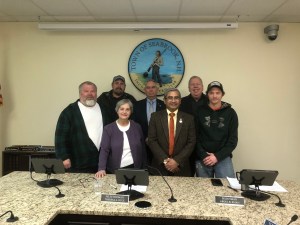
The Board of Selectmen announced a one year contract agreement with the Seabrook Police Association, affiliated with Teamsters Local 633, this week. The agreement will have a “true zero” for FY 2020, with a 2.5% wage adjustment beginning January 1, 2021. There are educational and longevity incentives included, and those changes are also deferred until January 2021. This unit has been without a contract for several years. My thanks to the Teamsters, the SPA, and the Board of Selectmen, who worked very hard on this agreement.
The Seabrook Board of Selectmen announce Collective Bargaining Agreement with SPA
The Seabrook Board of Selectmen announced this week a one year Collective Bargaining agreement with the Seabrook Employees Association, affiliated with Teamsters Local 633. The SEA is the largest of the Town of Seabrook’s employee unions, covering our DPW, Water, Sewer and some Police and Fire employees, as well as most of the clerical staff. This one year agreement will be on the ballot in March 2020, and would become effective, if passed, on April 1, 2020.
The contract has a “true zero” for FY 2020, with a wage increase of 50 cents per hour beginning on January 1, 2021. On the management side we appreciate the work and good faith shown in the negotiations by the SEA and Teamsters Local 633. The Board of Selectmen worked very hard on this contract and deserve recognition for that effort. This unit has been without a contract since 2017.
The Board of Selectmen announce a one year CBA with the SEA
My thanks to the Hampton Chamber, and President John Nyhan, for the great honor of being selected as the recipient of the Chamber’s President Award at the 2020 annual dinner coming up next week. It truly is a team effort in Seabrook, and I thank the Board of Selectmen, and the staff, for all of their support and hard work. I am looking forward to the annual dinner, being held this year at “The Brook” in Seabrook. Hope to see you there.
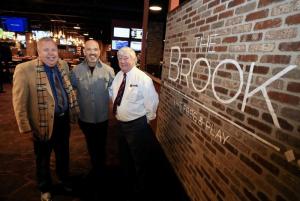
The Seabrook Board of Selectmen led a delegation of Town officials to the soft opening of “The Brook,” the newly renovated facility at Seabrook Park, the old Yankee Greyhound facility. This continues the major investment and upgrade of the facility since the purchase by Eureka Gaming. The newly opened facility will feature entertainment, sports viewing, pari-mutuel wagering, and gaming. The facility features multiple screens to view the action, beautiful and comfortable seating, and some delicious food options. Sports wagering has been accepted in New Hampshire, and will be on the ballot in Seabrook in March. If successful sports gaming will likely be added to that menu. We are very grateful for the investment in Seabrook, which has brought jobs, and additional tax revenues for the Town, as well as major infusions to local charitable organizations. Our thanks to Greg Lee and Andre Carrier for their hospitality and for bringing a first rate organization to Seabrook.
At the soft opening of “The Brook” at Seabrook Park.
Congratulations to Mayor Elect Neil Perry, who will be sworn in Monday January 6, 2020 at Methuen High School at 6:00 p.m. Mayor Perry will be Methuen’s sixth Mayor of the modern era following the Charter change that brought us the Mayoral form of government in 1993. Methuen changed to a Town Administrator/Council form in 1973 and then a Town Manager/Council form of government after abandoning Town Meeting. After the 1993 change Methuen had its first Mayoral election since Samuel Rushton won the office before 1920. Mayors, by Charter, are limited to three two year terms. Let us take a look at how those six Mayors won office.
In 1994 Dennis DiZoglio led the ticket in the very large primary field, and then defeated a young upstart City Councilor named William Manzi in the final election. Mayor DiZoglio won three terms as Mayor, and during his tenure the school system built the three K-8 grammar schools (Marsh, Tenney, and the Timony schools.) Mayor DiZoglio had served as the Planner in Taunton and Peabody, and after his three terms were served in Methuen he became the General Manager of the MBTA for Planning and Development, and he retired as the Executive Director of the Merrimack Valley Planning Agency.
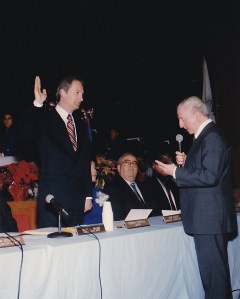
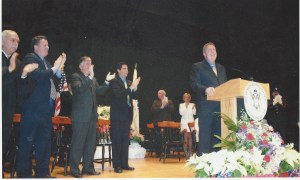
Mayor DiZoglio sworn in by Town Clerk James Maloney.
Mayor DiZoglio gives his Inaugural address.
Mayor Sharon Pollard won the first of her three terms by defeating City Councilor Larry Giordano in her first run for that office. Mayor Pollard was a former State Senator, and a former Secretary of Energy for the Commonwealth of Massachusetts, working for Governor Dukakis. A little remembered fact is that then City Councilor Steve Zanni was in that preliminary election for Mayor.
Mayor Pollard posing with the Manzi family at her Inaugural
Following Mayor Pollard was Mayor William Manzi III. (Yes, the same one that lost to Mayor DiZoglio.) In my initial race I defeated Ellen Bahan for the office. I also served three terms, and was very happy to secure the state financing for the Methuen High School project, becoming one of the first High Schools in the Commonwealth to be approved for funding under the newly created state system of funding local school infrastructure. Our financing package enabled Methuen to complete a $100 million project without requesting a Proposition 2.5 override.
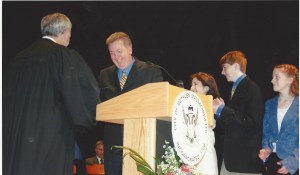
Jim Jajuga swears in Bill Manzi in 2006.
Speaking to the crowd at the Tenney School in 2006.
The third Manzi Inaugural, in the Great Hall, Searles Building.
Mayor Stephen Zanni defeated Al Dinuccio in 2011, following Mayor Manzi in office, and twice won re-election. Mayor Zanni’s tenure included the completion of the Methuen High School project, and the total renovation of Nicholson Stadium, including brand new artificial turf. Mayor Zanni had served Methuen as a School Committee member, as well as being a Methuen City Councilor, and past Chairman of that body. A little remembered fact on Mayor Zanni is that he was a member of the Lawrence School Committee before moving to Methuen.
Mayor Zanni sworn in by City Clerk Tina Touma-Conway.
Mayor Zanni poses with the newly elected City Council 2012.
The Four Mayors of the modern era pose at the Inaugural of Mayor Zanni in January of 2012.
With Mayor Zanni at his second Inaugural, at the Methuen Memorial Music Hall, 2014.
With Mayor Zanni at his third Inaugural, with City Councilor Ron Marsan.
Mayor James P. Jajuga succeeded Mayor Zanni, winning election in 2017 while running unopposed. Mayor Jajuga is a former State Senator, has served as the Massachusetts Secretary of Public Safety,as well as having a long and distinguished career as a Massachusetts State Trooper. As a State Trooper Mayor Jajuga headed the Regional Drug Task Force. Mayor Jajuga also served as a Methuen City Councilor before becoming Mayor. Mayor Jajuga served one term, opting not to run for re-election in 2019. During his tenure the Methuen Rail Trail was completed, a major infrastructure project connecting Methuen to the regional trail system.
Mayor Jajuga is Sworn in as Methuen’s Fifth Mayor of the Modern Era.
The Five Mayors of the modern era pose at Mayor Jajuga’s Inaugural
Methuen’s Elected Officials in a group photo.
With New Hampshire Senator Lou D’Allasandro visited Methuen for the Inaugural of James Jajuga
Mayor Neil Perry led the ticket in a four way primary in 2019, defeating Dan Shibilia and Don Riccio, and leaving City Council Chair Jennifer Kannan as his opponent in the general election. Mayor Perry defeated Councilor Kannan, succeeding Mayor Jajuga and becoming Methuen’s sixth Mayor of the modern era. Mayor Perry started his career as a teacher in the Methuen public schools, and followed that with a 30 year career in management at Raytheon. He holds an MBA from Southern New Hampshire University, and is a distinguished alumni of Central Catholic High School. Mayor Perry officially assumes his duties on January 6, 2020. Best wishes for a very successful term for the Mayor and the newly elected City Council.
Every four years we hear that the upcoming Presidential election is the most important in history, and there is no question that each one carries special ramifications for the country. As we gaze back we can identify, with the benefit of some hindsight, key “pivot points” in history. The Presidential election of 1968 most certainly falls into that category. Michael A. Cohen has written a book that takes us back through the tumultuous political year of 1968 that did so much to change the country, bringing us political divisions that have broadened and hardened. It started in 1968.
The election of 1968 brought us some of the biggest political personalities in American history, people that impacted American politics for years to come. On the Republican side you had George Romney, Nelson Rockefeller, Ronald Reagan, and Richard Nixon, with the Democrats featuring LBJ, Hubert Humphrey, Robert Kennedy, and Eugene McCarthy, with a little peek at George McGovern. And of course you had one of the greatest demagogues in American political history, George Wallace, running as an independent.
The story starts with the smashing LBJ victory over Barry Goldwater in 1964, and how the Johnson Great Society, civil rights programs, and conduct of the Vietnam War started the great political backlash that brought us to 1968. LBJ recognized that he would be spending down political capital after 1964 but he simply could not reconcile his Vietnam policies with a changing political landscape in the country. He did not spend down political capital as much as he burned it thoroughly. The Democrats lost 47 seats in the U.S. House in 1966, although maintaining control, as well as 3 seats in the U.S. Senate, as well as a loss of 7 governorships. (Ronald Reagan defeated Pat Brown in California in 1966.)
Johnson’s attempt to thread the political needle between newly empowered Democratic constituencies, on the rise after 1964, and the traditional power base of the Party, faltered, despite his very formidable political skills. LBJ speechwriter Horace Busby presciently said “America’s real majority is suffering a minority complex of neglect. They have become the real foes of Negro rights, foreign aid, etc., because as much as anything, they feel forgotten, at the second table behind the tightly organized, smaller groups at either end of the U.S. spectrum.” Cohen highlights the backlash, in large part a racial one, by observing “These strains contributed to an emerging political movement of white anger and frustration, which after Watts threatened not only Johnson’s presidency but the very aspirations of American liberalism.”
Cohen, Michael A. “American Maelstrom” Page 21
The backlash was on. Cohen brings forward the candidates in 1968, one by one, with a really first rate look at their candidacies, positions, and how they fit into the larger set of changes occurring in the country. Cohen’s quick analysis of the LBJ political failure on Vietnam, and how that failure not only forced him from the race, but created the protest candidacy of Eugene McCarthy, and then the entry into the race of Bobby Kennedy, in my opinion hits the mark exactly.
“When finally forced to change course in March 1968, his dreams of a Great Society lay in tatters, his hopes for a second term had been dashed, and his party was mired in open revolt. In hindsight, the two moments were inextricably linked. Had Johnson shifted course in the fall of 1967, he almost certainly would not have been forced from the presidential race. A decision to de-escalate would have meant that Senator Eugene McCarthy-whose rationale for running was Johnson’s refusal to change his policy in Vietnam-would likely not have challenged the president for the Democratic nomination. No McCarthy would have also meant no Robert Kennedy candidacy. Instead, if he’d chosen to run, Johnson would have been the Democratic nominee for president in 1968, if as much by default than by universal acclaim.”
Cohen, Michael A. “American Maelstrom” Pages49-50
Cohen has some observations on the Democratic side that bring into focus the relative strengths and weaknesses of the candidates. Eugene McCarthy, whose challenge to LBJ brought out the political weakness of a sitting President, is the first, and maybe the best example of this in the book. Cohen clearly is respectful of the McCarthy role in 1968, but does not hesitate to show us his very great weaknesses as a candidate. The “Clean for Gene” movement of young people to the McCarthy candidacy truly did create a huge change in the Democratic Party. But McCarthy, as Cohen points out, was just not really interested in the job of being President. He most certainly eschewed, despite the protest nature of his candidacy, harsh or demagogic rhetoric on the campaign. His was a candidacy reflective of the man: reasoned, intellectual, and non-emotional.
Cohen manages to deconstruct much of the legacy of RFK’s candidacy in 1968. He is certainly a little less respectful of RFK than he was of McCarthy , and some of the shine of the RFK 1968 campaign is tarnished in the book. We get some terrific campaign narrative dealing with the McCarthy-Kennedy fight after Bobby got into the race, with some surprisingly bitter exchanges between the men and their campaigns. RFK’s refusal to get into the race against President Johnson until McCarthy had stepped forward was a constant sore spot with many. The charge of opportunism was never far behind RFK as far as the McCarthy people were concerned.
“Allard Lowenstein spoke even more glowingly of McCarthy. ‘We all had our heroes,’ said Lowenstein years later.’Jack Kennedy, Mrs. Roosevelt, but…none of them had ever been so heroic or had so many people owing him so much as Gene McCarthy. ‘ Lowenstein said it was something that Kennedy and his people could never fully appreciate. ‘They never understood the depth of feeling on the issues, and therefore, the depth of gratitude to McCarthy that he made the fight when Kennedy wouldn’t.’”
Cohen, Michael A. “American Maelstrom” Page 133
One of the most important figures that Cohen looks at, in my opinion, is George Wallace. The sections of this book dealing with Wallace, and his appeal outside of the South, are so very important. Wallace represented a racist populism that was always considered to be “conservative” but in reality was much more than that.
“In an interview with U.S. News and World Report in June 1968, Wallace nonetheless argued, ‘We are still against the philosophy of big government controlling every phase and aspect of our lives.’ In reality, Wallace wanted to redirect the flow from the government’s spigot rather than turn it off altogether. Indeed, conservatives regularly attacked Wallace for his “collectivist” views. James Ashbrook, the head of the American Conservative Union, blasted his candidacy as ‘repugnant to ideals of American conservatism.’ In fact, the overlap between Wallace and Goldwater voters was far less extensive than generally assumed. Only half of those who would vote for the Alabama governor in 1968 had voted for Goldwater four years earlier. Goldwater’s strongest backing came from those who considered themselves economically secure, while Wallace did best among the working class. Even given the reactionary nature of Wallace’s politics, his supporters were more likely to call themselves “liberals” than Nixon voters. Wallace voters had little apparent interest in the right’s ideological dogmatism. For them politics had become a zero sum game of resource allocation and government attention. More money and public programs for blacks meant less for them-and they wanted to protect what they had.” Cohen, Michael A. “American Maelstrom” Page 234-235 Wallace had created “Reagan Democrats” before Reagan, and his appeal to the white working class portended a larger realignment that would come to full fruition many years later. His rejection of “conservative” orthodoxy in favor of populist appeal looks very familiar today.
Nixon’s rise from the ashes of 1960, and 1962, is a story that has been covered extensively. We see a political master beginning to exploit newer methods of campaigning, and managing to at once say nothing specific but at the same time appeal to the public desire for some return to “normalcy.” The outlines of Nixon’s “Southern Strategy” and the huge realignment that followed that success flowed from his winning campaign in 1968. Nixon was a far more subtle candidate than Wallace, but he managed to appeal, in his way, too much of the constituency in the South that abandoned the Democratic Party over civil rights. Nixon, in my view, was and is, the architect of the modern Republican Party.
Cohen, through this book, gives us a great look at the monumental political year of 1968. It is not simply a retelling of the narrative, but allows us to transcend the candidates, and look at the ideas and strategies those candidates deployed that impact us to this very day. Get this book. You will both enjoy it, and learn from it.
The Board of Selectmen ratified the choice of Brett Walker as the new permanent Chief of Police in Seabrook this past week, approving his contract. Chief Walker has had a 16 year career with the Seabrook Police Department, serving as a patrolman, a detective attached to the Attorney General’s Drug Task Force, Lieutenant, Deputy Chief, as well as Acting Chief since the retirement of Chief Michael Gallagher.
From the press release:
“The Town of Seabrook deserves and needs first-rate policing, and with the growth in our community our Police Department faces new challenges,” Manzi said. “Brett Walker, through the depth of his experience, his knowledge of the community, and his commitment to innovation, will bring the leadership necessary to advance the department, and provide Seabrook residents with the very best in police services.”
It was a bit chilly but there was a nice crowd on hand for the Seabrook Tree Lighting last night. Our thanks to Charlie Mabardy, who donated the tree for the event. Thanks to the Seabrook Lions Club for all of their hard work, to DPW for all of the help on putting up the tree, to Seabrook Police and Fire for all of their work, and to the Board of Selectmen for all of their support for this event. A big thank you to Trinity United Church for the use of their hall.
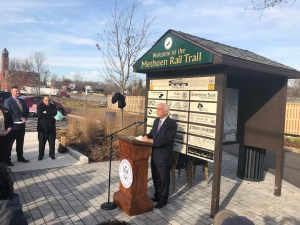
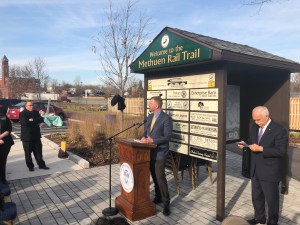
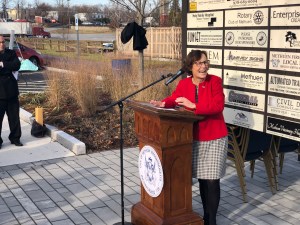
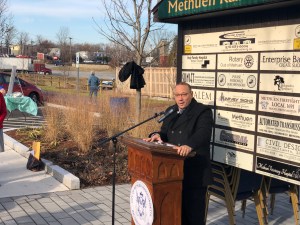
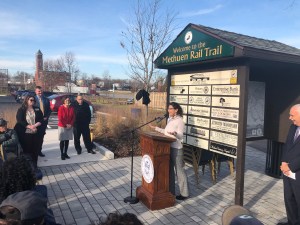
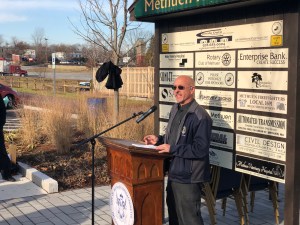
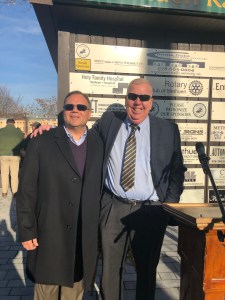
I was delighted to be able to attend the ribbon cutting for the Methuen Rail Trail, which occurred last week. The completion of this trail comes after the City secured a $1.95 million Gateway Cities Parks Grant, which is such a great indication of the first rate Legislative delegation that represents Methuen. State Senator Diana DiZoglio, State Representatives Linda Dean Campbell, State Representative Frank Moran, and State Representative Christine Minicucci all worked very hard to bring that grant to Methuen. Congrats to Mayor Jajuga for all of his hard work on this as well. Economic Development Director William Buckley and his first rate team really did an outstanding job in managing this process and keeping everyone on the right path. This entire project is a testament to the tenacity, hard work, and dedication of the Methuen Rail Trail volunteers, who have worked so hard over so many years. Check out their website.
A neat part of this project is the participation of the Greycourt Poets, who have added the “poets wall” with some wonderful works on display. My former Chief of Staff Matt Kraunelis, who worked diligently on this project during my Administration, has continued to contribute through the Greycourt Poets.
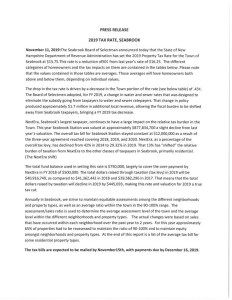
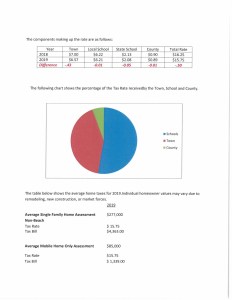
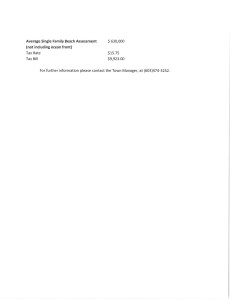
The Board of Selectmen today announced the Seabrook Tax Rate for 2019. That rate is $15.75, a 50 cent decline from last years $16.25. This rate decrease is in fact a tax decrease for the taxpayers of Seabrook, as the total dollars raised through property taxation will decline from 2018, a truly remarkable figure. (Property tax collection will decline by $445,693.)
The property tax decrease is driven by a 43 cent decrease in the Town rate. This decline is largely attributable to the policy decision made by the Board of Selectmen on water and sewer rates. Management identified a $2 million dollar subsidy going from taxpayers to ratepayers, and Selectmen voted to end that subsidy, beginning in 2019. In setting this rate the Board recognized approximately $1.7 million in additional local revenue.
The Board of Selectmen have additionally held the rate of discretionary spending to 2% or less for several cycles. This has also had a positive impact on the relative tax burden in Seabrook. The overall percentage of the tax levy paid by NextEra continues to decline. In FY 2019, with this rate, NextEra will be approximately 29% of the total tax levy, down from 42% in 2014. The Board of Selectmen have had to manage this decline while continuing to maintain services and keep the tax rate stable. NextEra is currently under a three year tax agreement with Seabrook covering 2018, 2019, and 2020 that is worth $36 million over the term of the agreement.
The Board of Selectmen have made a policy decision to build fund balance, which has been a principal way the “NextEra Shift” has been managed. There will be another post examining the history of fund balance in Seabrook for the past six years.
Great job by Assessor Angie Silva, Finance Manager Carrie Fowler, Deputy Town Manager Kelly O’Connor, and the entire staff in doing the work needed to get this rate approved by the New Hampshire DRA.
I have attached the reports I provided to the Board covering the water and sewer subsidy for FY 2018.


















 Bill Manzi.com