
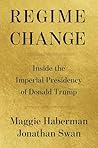
 Regime Change: Inside the Imperial Presidency of Donald Trump by Maggie Haberman
My rating: 4 of 5 stars
Regime Change: Inside the Imperial Presidency of Donald Trump, by Maggie Haberman and Jonathan Swan, was not a book I could resist. I confess to being addicted to the Bob Woodward style looks at the Presidencies of the day. Woodward got three books out of the Trump era, and yes I read them all. I also read most of the Woodward books on the other Presidencies he covered, and got to The Divider, the Peter Baker/Susan Glasser look at Trump’s first term. ( Yes I read the Biden book too) As “non-traditional” as some of the Trump first term may seem the second term is fundamentally different, and this book brings us not only a look at the second term to date, but the changes in the presidency that have accompanied Trump’s return to power. Haberman and Swan have covered Trump as closely as virtually any journalists in America, and their access to the people around him gives this book a remarkable level of detail. Much like Woodward the authors had extensive access, including a fascinating talk with Trump.
The central argument of the book is contained in its subtitle. The authors believe that Trump has created what amounts to an “imperial presidency,” with many of the institutional and personnel restraints that limited him during his first term either substantially weakened or simply gone. With the largely favorable rulings issued by the Supreme Court on presidential authority we have moved ever closer to the “unitary executive” envisioned by many GOP theorists. (Bill Barr was and is a unitary executive supporter) Many so called “guardrails” that limited past presidents have been shown to be voluntary, or grounded in dubious legality. Trump has simply mowed down those guardrails across so many different areas. Trump’s first term had staff that simply would not go along with many of Trump’s more radical ideas. (Mattis, McMaster, et al.) Trump learned from that experience. The second time around he arrived in Washington with a much clearer understanding of presidential power, and surrounded himself with people selected in large measure for their willingness to carry out his total agenda. Trump’s four years out of office gave him time to plan a return that would be staffed by people 100% committed to carrying out his agenda. Despite the Trump campaign denying any association the Project 2025 group provided the intellectual basis for a potential Trump return to power. There would be no half measures, and a new Trump Administration would actively seek to purge the federal bureaucracy of any staff not wholly supportive of the MAGA agenda.
There is an astounding amount to cover, including Trump’s efforts to resize the federal government, his rather open weaponization of the Justice Department, his battles with the courts, tariffs and the restructuring of American trade policy, immigration, and the enormously consequential foreign policy decisions of his second term up to now. As with so much involving Trump, policy and personality are almost impossible to separate. We see a President who is a gut player, relying on instinct rather than process and careful policy study. (The national security apparatus is essentially shelved.) They also show a President much more comfortable exercising the enormous powers of his office than the man who first arrived in Washington in January of 2017.
The book is filled with the type of inside reporting that has become Haberman’s trademark. Some of the anecdotes are almost comical, while others reveal important information about how decisions are actually made.
“Lutnick told those around him that Musk intended to eliminate a trillion dollars of government waste, while Lutnick personally would bring in a trillion for the country by raising tariffs, sealing tax loopholes, and pursuing a more aggressive strategy around America’s natural resources and tangible assets. Together they would eliminate the federal deficit.”
Regime Change: Inside the Imperial Presidency of Donald Trump. Haberman, Maggie and Swan, Jonathan. Pg. 44
The national debt just hit $40 trillion so Lutnick’s rather ambitious goal has come up a bit short.
Some great insights into the Trump-Musk dynamic beyond DOGE. That relationship was bound to explode at some point but it has been repaired, as it is difficult to let Musk go entirely with all of that money ready to be deployed for the GOP.
Trump emerges as an extraordinarily unconventional President who operates through a relatively small circle of trusted advisers and frequently approaches enormously consequential decisions in a manner that would be almost unimaginable in previous Administrations. Trump, in my view, lives in a cocoon, but it is a cocoon with a wide net. He does talk to many people, but practically none who might push back on an idea. Some might say that the President can lose touch with reality under those conditions, but I submit that for Trump it is an irrelevancy. Even when he did get pushback he would only modify under the most extreme conditions. He lives in his own reality, and seeks to change that reality to his preference on a daily basis.
Trump himself was not happy about the book and launched his somewhat standard line of attack on the authors after publication. That likely means most Trump supporters will feel the same way. MAGA likely views the weakening of the traditional Washington restraints described in this book as a positive rather than a defect. They elected Trump precisely because they wanted him to disrupt institutions that they believe have become unaccountable and hostile to their interests. His opponents will see many of the same actions as dangerous attacks on constitutional norms and the traditional limitations on presidential authority. That split, in my view, deserves a bit more attention. While Trump has, without question, exacerbated the divisions both parties need to be called to account for essentially being entirely without credibility on this split. Todays GOP supporters of expanded Presidential authority will be the first to call the exercise of that authority an abuse with a Democrat in the White House. Many Dems being critical today will likely be on board for a Democratic President using some of the newly found Presidential authority. The GOP may come to rue the day that they were so supportive of that expansion, but it is an expansion that is unlikely to be rolled back no matter who wins in 2028.
There have now been countless books about Donald Trump, many of which have been written either to condemn him or defend him. Regime Change is more useful than most because the authors concentrate heavily on how Trump actually operates. Whatever your political views, it is difficult to read this book without recognizing that the second Trump presidency represents something substantially different, not only from his first Administration but from the traditional American presidency.
Trump has been the dominant figure in American politics for more than a decade, surviving political defeats, two impeachments, criminal prosecutions, and controversies that would have ended the careers of almost any previous American politician. He returned to the White House not chastened by those experiences but seemingly emboldened by them. The authors make a compelling case that understanding that fact is essential to understanding his second presidency. Whether the changes they describe ultimately represent a dangerous concentration of presidential authority or a long overdue challenge to an entrenched political establishment will continue to be fiercely debated. But there can be little doubt that Donald Trump has changed the presidency, American politics, and the Republican Party in ways that will survive him.
As mentioned I am hooked on the “insider” accounts of Presidential Administrations. I do believe they have value, and most bring some level of entertainment as well. (The gossip and positioning always brings some level of entertainment) The book, as mentioned, brings us a great look at the Trump operation, which has to bring us to Stephen Miller. Miller has been the driving force behind the immigration crackdown that is such a major part of the second Trump term. Even Trump seems, at some level, to get the fanaticism of the true believer Miller on that topic.
“Miller was different. He was a true believer, more hard-line than the President he served, and he didn’t flinch. Trump would acknowledge that difference and joke about it in private. In a 2024 campaign meeting,Trump remarked that if it were left to Miller there would be only 100 million people in the United States and they would all look like Stephen Miller.”
Regime Change: Inside the Imperial Presidency of Donald Trump. Haberman, Maggie and Swan, Jonathan. Pg. 98
One more anecdote from the book that I found interesting. Scott Bessent, Trump Treasury Secretary, used to work for George Soros. He actually compared Trump to Soros.
“ ‘They are the same animal,’Bessent would say to others. ‘But George is in the market. President Trump is political. Incredible propensity to take risks, and incredible survival skills. And they oscillate between pushing the risk, cutting the loss.’ “
Regime Change: Inside the Imperial Presidency of Donald Trump Haberman, Maggie and Swan, Jonathan. Pg. 120
For students of American politics and presidential history I think this book is an important account of an Administration that is still making history as the authors write about it. That necessarily means that some judgments will have to await the perspective that only time can provide. But the authors have produced a detailed and highly readable account of how Donald Trump returned to power, what he learned from his first presidency, and how he has used that knowledge the second time around. Love Trump or hate him, understanding his impact on the American presidency is essential to understanding American politics today. Regime Change is an important contribution to that understanding, and a must read for those interested in politics, presidential power, and American history.
View all my reviews
-
Recently Written
- A Look at American Scoundrel: Roy Cohn’s Dark Journey from Joe McCarthy to Donald Trump
- Sidewalk Labs and the Smart City That Never Was
- A Look at “He Has the People: Abraham Lincoln and the Election of 1860” by Jonathan Earle.
- A Look at Regime Change by Maggie Haberman and Jonathan Swan
- A Look at “Blood and Ruins: The Great Imperial War” by Richard Overy
- A Look at Patton: A Genius for War by Carlo D’Este
- A D-Day Remembrance
- Tony Blair on the Problems of Labour: Lessons for Democrats?
- The Battle of Iwo Jima
- Seabrook Memorial Day Celebration 2026
Archive
Categories
- Appeasement
- Books
- Brexit
- Capital Improvement Plan
- Casino Gaming
- Education
- Education Reform
- Electoral Map
- Fifth Congressional
- Greece
- Health Care Reform
- History
- International
- Ireland
- Israel
- Manzi in the Morning
- Media
- Merrimack Valley Politics
- Methuen
- Methuen City Council
- Methuen Mayor's Race
- Mossad
- Munich Conference
- Municipal Finance
- municipal technology
- Music
- National News
- NextEra
- Resiliency
- Seabrook
- Sidewalk Labs
- smart city
- Song of the Week
- Sports
- State News
- Surveys
- Technology Beat
- Toronto
- Transportation Finance
- U.S. Senate Race
- Uncategorized
- WCAP Podcast

