Seabrook Water Department Superintendent Curtis Slayton and Chief Operator George Eaton talk about warrant article 5, dealing with the maintenance of the two Seabrook water towers. This is a vital article, as this maintenance is overdue, and necessary for the continued operation of the water towers, a critical part of Seabrook’s water infrastructure. Seabrook’s Town election is March 12, 2019.
Mayor James P. Jajuga offered his second State of the City Address on February 20, 2019 at the Methuen Senior Activity Center. Due to my advanced age I missed the first 30 seconds or so of the Mayor’s speech.
I was very sorry to hear of the passing of Ken Henrick, who served Methuen in many different capacities over the years, as well as serving his country as a Marine. I had the unique pleasure of serving with him on the Methuen City Council, with the term starting in 2000. While we did not agree on all issues we became friends, and I enjoyed his company very much. We did have some fun together, usually at my expense. He had a great wit, which he deployed frequently, and while he could be tough he truly cared for people, and he was always willing to talk through problems and try to find reasonable compromise. Thoughts and prayers for his family. We will miss him.
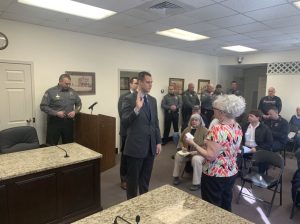
The Board of Selectmen welcomed two new police officers, John DiFrancesco and Anthony Robinson, at their February 4, 2019 meeting. The officers were sworn in by Clerk Cheryl Bowen, with the Board offering congratulations, and support for our public safety personnel. Congratulations to officers DiFrancesco and Robinson.
The Nuclear Regulatory Commission will hold a public meeting on the Seabrook Station License amendment and License extension on February 13 from 6 to 9 p.m. at the Best Western Plus-The Inn at Hampton, 815 Lafayette Road, Hampton, NH. The N.R.C. meeting notice is attached.
The Seabrook Deliberative Session is tonight, Tuesday February 5, 2019, at 7:00 p.m. at the Seabrook Community Center, 311 Lafayette Road. The Town warrant is included below. Hope to see you there.
The Hampton Bridge project will have an informational meeting at the Seabrook Community Center, 311 Lafayette Road, on Wednesday January 30, 2019 at 7:00 p.m. The meeting flyer, from N.H. DOT, is below.
The Seabrook Board of Selectmen and the Professional Firefighters have reached a collective bargaining agreement that covers one year. The contract contains no wage, or non wage, increase in benefits for the duration of FY 2019. The financial analysis required by law is contained in the below warrant article, which shows the tax impact in FY2019 as zero. The contract, in FY 2020, grants increases in the area of longevity and educational stipends. These adjustments are part of the Board’s policy to create incentives for professional development, as well as for professional longevity in Seabrook. The required financial analysis for FY 2020 is in the below warrant article. Thanks to the Seabrook Firefighters for all of their hard work on this contract.
ARTICLE 11
To see if the Town will vote to approve the cost items included in the collective bargaining agreement reached between the Board of Selectmen and the Seabrook Professional Firefighters Association for the period April 1, 2019 through March 31, 2020; and furthermore to raise and appropriate the sum of Zero Dollars ($0) for fiscal year 2019, such sum representing the additional costs attributable to the increase in salaries and benefits required by the new agreement over those that would be paid at current staffing levels. The increases in salaries and benefits for fiscal year 2020 would be $118,196. (Majority vote required) (Recommended by the Board of Selectmen) (Recommended by the Budget Committee) (Estimated $0 impact per $1,000 on the tax rate).
A detailed look at the Vietnam tragedy by author Max Hastings. Hastings effort is not simply a rehash of the American war effort but an attempt to look at all of the forces that converged, like a perfect storm, on Vietnam, causing death and misery, for the Vietnamese people. He begins with Ho Chi Minh, and takes us through the post World War II French reassertion of colonial rights in Vietnam. The French colonial regime was a precursor to the American effort many years later, suffering the same hubris, arrogance and stupidity that led to the failure of both. Hastings determination to show how this situation evolved, and how American administrations dating back to Harry Truman simply made error after error, is necessary to a full understanding of how the United States ended up with the disaster that was the war in Vietnam.
Hastings applies criticism across the board, not simply upon the U.S. He is harshly critical of the communist North, and takes a very different view of Ho Chi Minh than many. His criticism extends to the American left, who he accuses of taking a rose colored view of Ho and the communist North. There can be no doubt that the North engaged in brutal wartime tactics, and that the anti-war narrative largely omitted such acts. The miscalculations by the North were in fact numerous, and although Hastings is also very critical of the U.S. effort I think his strong anti-communist bent influences some of the writing. In spite of this Hastings is fair and evenhanded in his account and includes so much that readers can make up their own minds. as he begins, before the French get back after WWII, he relates this:
“The suddenness with which the war ended in August 1945 enabled Ho to seize the initiative, to fill a power vacuum that yawned widest in the north. His emissaries persuaded Bao Dai, Vietnam’s whimsical and indolent young puppet emperor, to write to the Paris government, asserting that the only way to safeguard France’s position was “ by frank and open recognition of the independence of Vietnam.” Gen. Charles de Gaulle, interim master in Paris, declined to respond to this missive but was obliged grudgingly to notice that, before abdicating on August 25, Bao Dai had invited Ho to form a government. The Vietminh leader marched his followers into Hanoi, Tonkin’s capital, and on September 2, 1945, proclaimed before a vast and ecstatic crowd in the city’s Ba Dinh Square the establishment of a Vietnamese state. He declared: “ The French have fled, the Japanese have capitulated, Emperor Bao Dai has abdicated, our people have broken the fetters which for over a century have tied us down.” The news was broadcast throughout the country, and a schoolboy who lived south of Hue later recalled, “ Our teachers were so happy. They told us we must go out and celebrate independence. They said that when we are old men . . . we must remember this as a day of celebration.” Ho in his speech quoted from the US Declaration of Independence and secured a propaganda coup when the OSS group allowed itself to be photographed saluting the Vietminh flag-raising ceremony. By chance, at that moment a flight of USAAF P-38 fighters roared overhead: in the eyes of thousands of beholders, the US thus laid its blessing upon the new government. In truth, of course, a cluster of idealistic young State Department and OSS men merely exploited Washington’s lack of a policy to make their own weather. Patti, upon whose considerable vanity Ho played like a lutenist, described the Vietminh leader as “a gentle soul,” and another American said, ‘We felt that he was first a nationalist, second a communist.” The major admitted long afterward, “ I perhaps was somewhat naïve with respect to the intent and purpose in using the words [of the 1776 Declaration]. . . . But I felt very strongly that the Vietnamese had a legitimate gripe or claim, to really govern themselves. After all what was [the Second World] War all about?’”
“It seems narrowly possible that Vietnam’s subjection to communism could have been averted if France in 1945 had announced its intention to quit the country and embarked upon a crash transition process, to identify credible indigenous leaders and prepare them to govern, as did the British before quitting Malaya. Instead, however, the French chose to draft a long suicide note, declaring their ironclad opposition to independence. The colonialists’ intransigence conceded to Ho Chi Minh the moral high ground in the struggle that now began to unfold.”
Vietnam: An Epic Tragedy, 1945-1975 by Max Hastings
Despite Hastings aversion to the eventual communist victory he freely points out that a multitude of errors by French, and then American, governments brought that result home. It was not clear to me that Hastings ever conceded the point that the Vietnamese people had the right to choose their own government, and leadership of that government, even if the choice was Ho Chi Minh. If the Americans had simply supported that right, and allowed for an independent Vietnam in 1945, the horrors imposed on the country in the name of the French, the Americans, and the North, would have been averted.
“More puzzling than France’s rashness and inhumanity was US willingness to support them. Without military aid, Paris’s colonial policy would have collapsed overnight. Fredrik Logevall observes that there would have been no contradiction about an American decision to assist France’s domestic revival while withholding backing for its imperial follies. Washington’s contrary call was made partly because, even before the Cold War became icy, policy makers recoiled from acquiescence in communist acquisition of new territorial booty. While American liberal intellectuals detested colonialism, in an era when much of their own country was still racially segregated, the spectacle of white men lording it over “lesser races” did not seem as odious as it would soon become. In the late 1940s, French policy was less closely linked to US anticommunism than it later became, but the interests of the Vietnamese people—or for that matter of their Malagasy, Algerian, and suchlike brethren—ranked low in the priorities of President Harry Truman.”
Vietnam: An Epic Tragedy, 1945-1975 by Max Hastings
The errors started there, and Hastings does not shy from that fact. The book does go way beyond the political, bringing us real life accounts from all sides on the ground. The true misery of this war, and the enormous toll it took on the Vietnamese people, and the boots on the ground from the North and the South, as well as the U.S., are related in chilling detail. It is one of the truly outstanding pieces of this book. We are moved from the high political offices to the fighting soldiers on both sides, with incidents that reveal how the foot soldiers suffered with out of touch leaders on all sides of the conflict.
The American story is one that has been told in several books. I think Hastings does bring some new perspective. (I found the relating of the Tonkin incident(s) illuminating.) The mistakes, the lies, the pure cynicism of the American war effort brought disaster to the people of Vietnam, and to the American military, and Hastings holds back nothing.
In line with what I think are his “predispositions” on the subject Hastings essentially glosses over the international Geneva conference of 1954, which paved the way for the French exit after the military victory of the Viet Minh over the French at Dienbienphu. Another instance where a “temporary” settlement was achieved, with the prospect of self determination for and by the people of Vietnam. What happened at the Geneva conference?
“On July 20, a partition was agreed between the French and the Vietminh close to the 17th parallel, which gave the new South Vietnam a short, defensible border with the North. This partition “would be provisional and should not in any way be interpreted as constituting a political or territorial boundary.” All Vietnamese were granted a three-hundred-day grace period in which to decide under which regime they would henceforth live, with guaranteed freedom of movement northward or southward. General elections would be held within two years. Both Vietnams would join Laos and Cambodia as avowed neutral states. The French would go home.”
The entity known as South Vietnam was carved out of this agreement, despite the clear terms that the partition was temporary, and did not constitute a “political or territorial boundary.” What about the elections? The U.S., and the “government” of South Vietnam balked at holding them, and giving the Vietnamese people a chance to unify under a government of their choice. Why? Everyone knew, and accepted, that Ho Chi Minh would be the election winner. With the U.S. confident of a Ho victory they simply refused to hold the election. Geneva has never been covered extensively, as far as I can tell, in the U.S., and you can see why. We intended to fight for democracy by thwarting democracy? Hastings glides by this by stating the U.S. position that there was no obligation to uphold any Geneva provisions since the U.S. had not been a signatory. (Another legacy of failure by John Foster Dulles) Nixon’s role here, as Eisenhower’s Vice President, a full fourteen years before he became President, is not explored.
“The Geneva Accords, as they became known, merely settled terms of truce between the departing French colonialists and the communists, who were to assume governance of the North. Therein lay the basis for the later insistence of both Washington and Saigon that refusal to conduct national elections within the specified two years was no breach of anything to which either had consented.”
Vietnam: An Epic Tragedy, 1945-1975 by Max Hastings
As we can see the mistakes started with Truman, but certainly did not stop there. The Eisenhower/Nixon Administration made, in my opinion, a major mistake by ignoring Geneva. The only outcome that mattered to them was stopping communist expansion, notwithstanding the legitimate aspirations of the Vietnamese people. Hastings, correctly in my view, bears down on the “who lost China” political backlash as being a major reason for the American attitude. Republicans stoked those political flames with Joe McCarthy and yes, Richard Nixon. The mistakes in Vietnam did not start with John Kennedy. The fear of Democratic Presidents to be tarred with the soft on communism tag, or being the President that allowed the dominoes to begin to fall in Southeast Asia, in my opinion, dominated the thinking of Lyndon Johnson, and brought him to disaster.
I was lucky enough to get this book free through my subscription to the Wall Street Journal, but it is worth paying for. Despite some disagreements that I have I count it as an outstanding effort, a book that will help those interested to a fuller understanding of the conflict in Vietnam.
A very good book that takes us through the failures exhibited by all levels of government in Flint, Michigan that led to a poisoned municipal water supply. First and foremost this book is about the human impacts of the failures, which left the citizens of Flint with a poisoned water supply. How did it happen, and could it have been avoided? Anna Clark shows us the failures, which were attributable to some grievous errors by local, state, and federal government. The human costs of these errors are highlighted as well as how local government in Flint was administered, and what role the administration of local government played in the disaster that unfolded there.
Flint, like many older urban areas that relied on auto manufacturing, first lost industry, followed by a steep decline in tax revenue, and eventually population. Flint’s financial problems were exacerbated by the State of Michigan diverting “local aid” (sharing of state sales tax revenues) from Michigan localities to the state budget. It was, for Flint, the perfect economic storm. In looking at local governance the Flint water story is inexorably linked to the Michigan law that created a system of “emergency managers” for localities experiencing financial difficulties. The state law in Michigan, allowing the Governor to appoint an “emergency manager” (initially referred to as an “emergency financial manager”) took on several forms over the years, and was actually wiped off the books by Michigan voters in a referendum in 2012. (Public Act 4) The Michigan Legislature quickly enacted a replacement (Public Act 436) that brought back the ability of the Governor to replace local government with a state appointed manager, which Governor Snyder used to appoint the Flint emergency managers leading up to, and during, the crisis. The issue of the relative merits of state appointed oversight of local government is deeply entwined in this story, as the Emergency Managers that were appointed did a shockingly poor job of administration.
Anna Clark takes us through the poor decisions, initially made at the local level by emergency managers and elected officials, that brought Flint into water crisis. These poor decisions were compounded by inexplicable, and serious oversight failures by the Michigan Department of Environmental Quality, (MDEQ) the Michigan agency charged with oversight of local decisions in order to determine that both state and federal law and regulation are being complied with. The EPA, representing the federal government, failed in their oversight duties as well, allowing a major piece of the Federal Clean Water Act to be ignored by Flint and the MDEQ.
So what happened to put Flint into this terrible situation? Faced with what city leaders felt was price gouging from the Detroit water system, which supplied Flint (and many other localities) with clean water Flint determined to join a new water collaborative just being formed, the Karegnondi Water Authority. This decision immediately created the necessity for Flint to determine how they would secure water while this brand new authority was formed, and infrastructure built. From this basic decision error after error occurred that put Flint on the fast track to disaster. Some of those errors were later shown to be willful violations of law. The author, correctly in my view, takes on this initial decision as an error, and one that should have been examined closely by the state of Michigan. The determination to create massive additional capacity, at a huge cost, when existing capacity was more than sufficient to meet existing needs, has to be the first question asked, and the author covers it even though that decision, standing alone, was not the primary cause of the eventual disaster. From the book:
“A ready explanation for what had happened in Flint quickly took on the appearance of fact: a flawed and hasty decision motivated by careless and petty cost-cutting to meet a budget. But this was not quite the case. Flint’s move to join the new Karegnondi Water Authority—which is what precipitated its temporary switch to river water—was a long-considered plan, years in the making. It was also a strange one, since it involved building an entirely new drinking water system in a state that already had more than any other. The MDEQ was charged with monitoring all those utilities, but after years of budget cuts and instability its capacity was limited. The MDEQ had lost almost one quarter of its salaried employees—1,224 people. The drinking water office and the lab that tested water samples were both strapped, according to an exhaustive federal audit in 2010, even as they were expected to navigate a growing number of regulatory requirements. The water office lost 8.7 percent of its budget over the course of a decade, the Detroit Free Press reported, while the lab lost 43 percent of its full-time staff. Nonetheless, the MDEQ had “one of the largest, if not the largest, number of community water systems to regulate,” Snyder’s investigative task force noted. The KWA would add yet one more to the mix. And while it was touted as a solution to the exorbitant cost of water, the KWA in fact did nothing to address the core structural problems behind the problem of affordability in a shrinking city such as Flint. “In a state and in a region where we had excess water capacity, why did we think we needed more?” said Chris Kolb of the Michigan Environmental Council, one of the co-chairs of the governor’s task force. Why indeed. It’s fairly unusual nowadays for a public water system to be built from scratch. That’s especially true if the water source hasn’t run out or become toxic. But Jeff Wright, Genesee County’s drain commissioner, the leading proponent and eventual CEO of the KWA, lobbied fiercely, on the grounds of savings, independence, and stability. The arguments were persuasive: Detroit charged a premium for supplying water over a long distance, plus there were annual rate increases, and it didn’t allow Flint a seat on its board. The KWA would provide water from Lake Huron (the same source as Detroit’s system), it promised a cooperative model, and it would charge communities a fixed, flat rate. Michael Glasgow, who ran Flint’s treatment plant, saw another advantage: “I viewed the plant as a city asset that should be put to good use,” he said.”
Clark, Anna. The Poisoned City (pp. 161-162). Henry Holt and Co.. Kindle Edition.
Not only did Michigan allow a very large expansion of water capacity but they also allowed Flint to violate some financial rules in order to be able to afford the capital expense associated with the project. Flint’s financial position was precarious, as shown by the book:
“The KWA got what it needed to move forward. But how was the distressed city going to pay for its part? Flint was so broke that when it was offered loans in 2012 to improve its water infrastructure, it had to turn them down, even though half the debt would be forgiven. “When your pockets are empty, further debt is irresponsible,” said the emergency manager at the time. And in January 2013, an MDEQ report had detailed necessary repairs at Flint’s treatment plant but noted that the repairs could not “proceed due to the city’s current bond debt.” The efforts to sign Flint on to the new water authority were especially surprising, given that the state treasury, which approved the contract, was also responsible for the city’s financial well-being through the emergency management program—a system that’s supposed to make tough decisions, such as reducing debts and redundancies.”
Clark, Anna. The Poisoned City (p. 163). Henry Holt and Co.. Kindle Edition.
After the State approved the formation of the new authority (a $300 million capital cost) the issue of Flint’s financial participation in the venture, in light of the financial problems of the City, was front and center. How would Flint float additional debt when they were at “debt capacity?” From the book:
“So the state arranged a work-around: Flint’s share of the money for the construction of the KWA was given a special pass so that it did not count against the debt limit. The work-around was through something called an administrative consent order, or ACO. This is a tool that the state uses to force local governments to fix an urgent environmental problem, even if they must issue bonds that exceed their debt limit to do so. Even among state workers, the ACO raised eyebrows. In December 2013, an MDEQ employee received a call from an attorney “seeking what I’d characterize as a ‘sweetheart’ ACO intended to ease the city’s ability to access bond funding for their possible new water intake from Lake Huron,” as she described it in an email.42 The attorney and “Treasury officials have already been communicating with Steve [Busch of the MDEQ] about an Order of some sort in light of Flint’s financial situation.” KWA’s bond attorneys exerted pressure on the negotiations. In an email delivered to Earley and future EM Jerry Ambrose about a month before Flint’s 2014 water switch, one attorney said that “we cannot continue with the transaction without the ACO.” If the delay continued, “the KWA will have expended its initial resources and be forced to stop construction and the project will be delayed for at least one construction cycle.” Ambrose asked the Treasury for help, and an employee was instructed to “get a call into the Director,” presumably of the MDEQ, “to push this through.” The ACO was finalized two days later. It was written in a way to account for minor work on wastewater lagoons at the Flint treatment plant’s lime sludge facility—so to appear to address an urgent environmental problem—but it also covered the entirety of the KWA bond debt. To make sure that it would be legally intact, Stephen Busch and Flint’s environmental attorney conferred on the wording: “Steve, I checked with the City’s bond counsel, here is the Language that we MUST include in the consent order so that the City can move forward on this.”So the tool that was meant to fix an environmental emergency in this case included language that required Flint to “undertake the KWA public improvement project.” In this way, the KWA could count on a broke city to pay for almost a third of its construction. And it did this through the Treasury, which was the steward of Flint’s financial health. But the KWA actually added to Flint’s debt, and it bent state law to do so. Rather than borrowing to invest in schools or public safety, Flint ended up paying for a pipeline that literally paralleled one that already existed.”
Clark, Anna. The Poisoned City (pp. 163-164). Henry Holt and Co.. Kindle Edition.
This approval, given with state oversight, laid the foundation for the disaster that was to follow. It tends not to be the focus of the Flint water story but it caught my eye for obvious reasons. The serious criticisms of both the State of Michigan and of the actions of the emergency managers starts here, and is richly deserved. How anyone could approve lifting a debt cap in Flint for a project like this is simply not understandable, and defies basic tenets of municipal finance.
Flint compounded the initial financial error by determining to leave the Detroit system while waiting for the new authority to be able to deliver water. Flint, the owner of an antiquated water treatment plant, decided to retrofit that plant, and use it to deliver water to residents from the Flint river. That decision started Flint into the water abyss, and was made despite warnings that the Flint plant was not ready to produce quality water, and that the Flint River, as a water source, was problematic.
“But construction on the KWA hadn’t even begun yet. The new system wouldn’t be able to deliver water for at least a couple more years. Until it was ready, the other Genesee County communities that were moving to the new system simply paid the DWSD for continuous water service. Flint, however, made the unusual decision to enlist a different source of water during this transition period. The city turned to its emergency supply: the Flint River. To treat the river water, the old Dort Highway plant needed a series of upgrades. Many of these improvements would be required anyway, since the plant would soon have to treat raw water from the KWA.But getting the facility up to speed was difficult, and while cost estimates varied widely, only a fraction of the early figures proposed by the engineering consultants was spent on the project. The month of the water switch, Michael Glasgow, Flint’s utilities administrator, didn’t believe the plant was ready. He emailed three people at the MDEQ, the state environmental agency, with a warning. “I have people above me making plans” to distribute the water as soon as possible, Glasgow wrote, but “I do not anticipate giving the OK to begin sending water out anytime soon. If water is distributed from this plant in the next couple of weeks, it will be against my direction. I need time to adequately train additional staff and to update our monitoring plans before I will feel we are ready. I will reiterate this to management above me, but they seem to have their own agenda.”
Clark, Anna. The Poisoned City (pp. 17-18). Henry Holt and Co.. Kindle Edition.
“Stephen Busch, a light-haired district supervisor from the MDEQ’s drinking water office, was at the ceremony too. A year earlier, when the city was wrestling with its long-term water options, he had expressed worry about what would happen if Flint treated its own river for drinking water—bacterial problems, exposure to dangerous chemicals, additional regulatory requirements. In other words, the state’s environmental agency had thought that the city should avoid the Flint River. And now Flint was using the river anyway. For all his earlier concern, though, Busch seemed tranquil at the treatment plant that April morning. Regarding the drinking water, he said, “Individuals shouldn’t notice any difference.”
Clark, Anna. The Poisoned City (pp. 18-19). Henry Holt and Co.. Kindle Edition.
Once Flint threw the switch on the retrofitted water plant and began to draw water from the Flint River the errors just continued, and those errors were made at the local, state, and federal levels. Those errors led to water contaminated by lead, and other serious contaminants. Resident concern, and then resident outrage, was met with apathy, and multiple assurances that there was nothing wrong with the water. From the book:
“Explanations for the brown-tinged water were vague and contradictory. When asked about the discoloration by the dogged Ron Fonger of the Flint Journal, the city spokesperson said he wasn’t sure. A couple of weeks later, Mike Prysby of the MDEQ told a reporter in Detroit that the color was the result of workers’ “unauthorized drafting of water from fire hydrants in these areas for street sweeping activities.” That, plus frequent main breaks, stirred up sediment and rust in the pipes, which caused the discoloration. The unauthorized hydrant use, he said, “will be discontinued.” So some officials said that open hydrants would help solve the discoloration problem: they cleared the water by moving it through the system faster. Others said that open hydrants were contributing to the problem: the surge of water caused iron to flake off the mains. The city’s annual water quality report opted for an all-encompassing explanation: the rusty color was due to the “change in source water, water main breaks, and routine maintenance” that caused the cast iron pipes to deteriorate faster than usual. Among the steps taken to fix the problem would be more flushing—open hydrants—and budgeting for the repair of a twenty-four-foot water main in an unspecified “area of concern.”
Clark, Anna. The Poisoned City (pp. 39-40). Henry Holt and Co.. Kindle Edition.
The City simply put out bad information, and when they were forced to test they tried to create conditions that would help them to show results that were at odds with reality.
“The city turned in a total of seventy-one. As usual, collectors had been instructed to pre-flush the water. They also sidestepped the EPA guideline to focus on high-risk locations—that is, homes that are likely to be serviced by lead lines, where contamination would be expected to be more severe. Flint couldn’t easily find those homes even if it wanted to, since the records on the location of lead pipes were kept on decaying maps and spotty index cards. But after Rosenthal sent his warning, nearly one quarter of the final tests were done at a stretch of road where a major part of the water main had been replaced some years earlier. When mains are updated, lead pipes, if they are there, are often removed, too. In Flint, these samples recorded very little lead. Finally, the rules require that homes tested in the first batch in 2014 be retested in the second round to make it easier to spot changes in the water quality. Yet only thirteen homes were retested—and all of these had scored low lead levels the first time around.51 Despite all that, Flint still exceeded the federal limit on lead, according to a report dated July 28. Even by the state’s own numbers, Wurfel’s claims on Michigan Radio didn’t hold up. The water wasn’t safe after all. The state would have to work with the city on a major notification campaign, advising residents on how to protect themselves. But then the MDEQ did a curious thing. It supervised a revision of the results, with two of the seventy-one samples—both with extremely high lead—dropped from the calculation. One of them came from LeeAnne Walters’s home. Scrapping those tests brought the city’s lead level down to 11 ppb. That’s high, but within acceptable limits. When these revised results were made official, Michael Glasgow, Flint’s utilities administrator, added a handwritten note, “Two samples were removed from list for not meeting sample criteria.” LeeAnne Walters had been giving these public reports her close attention, and she noticed that her sample was excised. She wanted to know why. The MDEQ explained that she had a filter, which altered the water’s quality and invalidated the sample. (In fact, Walters had been told to remove the filter before the test, and she had done so.) The second sample was disqualified because it didn’t come from a single-family residence. Being stringent about the Lead and Copper Rule only when it lowered the lead count, while exploiting loopholes at every other turn, made the water seem perfectly compliant with the law.”
Clark, Anna. The Poisoned City (pp. 119-120). Henry Holt and Co.. Kindle Edition.
The bad faith shown by the above excerpt is outrageous, and these types of activities have led to multiple indictments. The State MDEQ was complicit, with that agency failing on multiple fronts. The above mentioned Lead and Copper Rule, part of the Federal Clean Water Act, is enforced in Michigan by the MDEQ, with oversight from the EPA. The initial move to the Flint River through the Flint water treatment facility made no provisions for anti-corrosion treatment of the water. That failure was a major reason for the calamity, as the Flint River water corroded aged lead pipes and leached lead into Flint’s water. The lack of corrosion control became a political football, but the EPA has recently issued an Inspector General report on that topic (and other regulatory failures of the EPA Region 5 office) that has shed some real light on that topic.
Ultimately this story had enormous human costs, bringing lead and other contaminants to the residents of Flint, harming adults, and having especially damaging impacts on children. Anna Clark has done a terrific job of bringing this story forward. There are so many important issues dealt with in this book, and the author covers them all admirably. I highly recommend this book.





 Bill Manzi.com