
From a letter I sent to the Eagle Tribune many years ago. I tend to put in some edits each year.
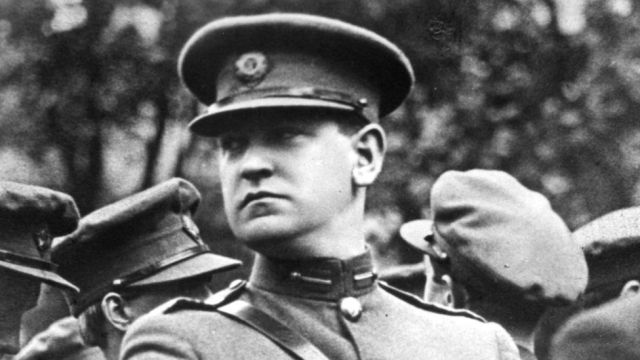
Each St. Patrick’s Day, we celebrate Irish identity—its culture, its resilience, and its history. But we don’t always reflect on the difficult decisions that helped shape modern Ireland. Few figures embody that tension more than Michael Collins, whom historian Tim Pat Coogan famously called “the man who made Ireland.”
Collins remains a controversial figure to this day. His decisions have been both praised as visionary and condemned as betrayal. That discomfort still lingers in some Irish republican circles. Yet history invites us to take a broader view. In particular, the 1998 Good Friday Agreement offers a useful lens through which to assess Collins’ legacy—and whether his most contentious decision was, in fact, the right one.
Collins’ reputation was forged during the Irish War of Independence, which began in 1919. He held multiple key roles in the Irish government, including Minister of Finance and Director of Intelligence. In the latter role, Collins built an intelligence network that successfully countered British operations while helping to develop the guerrilla tactics that defined the Irish Republican Army’s campaign. These strategies allowed a smaller, poorly equipped force to fight the world’s most powerful military to a standstill.
Central to that effort was Collins’ creation of “The Squad,” a small, highly effective unit tasked with eliminating British intelligence operatives. Their actions crippled British intelligence capabilities in Ireland while giving the Irish unprecedented insight into British plans. Collins’ contributions were so decisive that Arthur Griffith, founder of Sinn Féin, called him “the man who won the war.”
By July 1921, a truce brought an end to active hostilities, and negotiations began. The Irish position was complicated. The Easter Proclamation of 1916 had declared a fully independent republic governing the entire island. But it was increasingly clear that any agreement with Britain would fall short of that ideal.
In October 1921, Collins was sent to London as part of the Irish delegation, empowered to negotiate and sign a treaty. Notably, Éamon de Valera, the Irish President, chose not to attend, despite having led earlier negotiations. It was a decision that would have lasting and tragic consequences.
The resulting Anglo-Irish Treaty granted Ireland Dominion status within the British Empire, required an oath of allegiance to the Crown, and allowed Britain to retain control of certain ports. However, it also ended British military occupation in 26 counties and established the Irish Free State. Collins understood the compromise he was making, describing the treaty as “a stepping stone” toward full independence.
Critics then—and now—argue that the Treaty conceded too much, particularly in accepting partition and allegiance to the British monarch. Those concerns were not without merit. The Treaty split the Irish leadership, led directly to the Irish Civil War, and ultimately cost Collins his life.
Yet the longer arc of history tells a more complicated story.
Collins’ chief opponent, Éamon de Valera, eventually entered the Dáil in 1927 and took the very oath he had once rejected. Over time, he dismantled that oath and reshaped the Irish state—ironically using the political framework created by the Treaty itself. By 1948, Ireland had formally declared itself a republic. Collins’ belief that the Free State would evolve into fuller independence had been realized.
This brings us to the Good Friday Agreement of 1998. Like the Treaty of 1921, it required difficult compromises. It accepted that Northern Ireland would remain part of the United Kingdom unless a majority voted otherwise, and it amended the Irish constitution to remove its territorial claim to the North. These were not small concessions.
But the Agreement also brought an end to decades of violence and created a framework for peace that endures today.
The parallel is striking. In both 1921 and 1998, Irish leaders faced the same fundamental choice: hold fast to an ideal, or accept an imperfect settlement that could lead to something better. Collins chose the latter—and history suggests that choice was not only pragmatic, but necessary.
The evolution of the Irish Free State into a fully independent republic, along with the success of the Good Friday Agreement, underscores the foresight of Collins’ position. He recognized earlier than most that progress would come not in a single leap, but in stages.
Collins did not deliver the Ireland many had envisioned in 1921. But he made possible the Ireland that exists today—sovereign, stable, and at peace.
That may be the truest measure of leadership, and the most fitting legacy to remember each St. Patrick’s Day.
 Bill Manzi.com